How to Weigh Your Caravan: Public Weighbridges by State

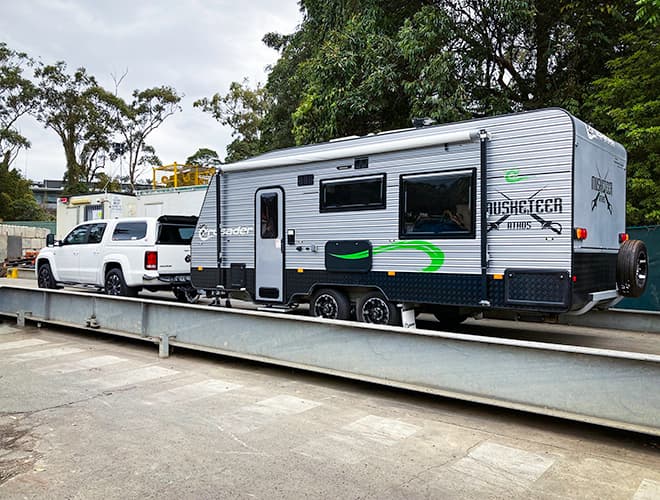
There is a moment on most people's first long trip where the thought arrives uninvited, usually somewhere around the third hill: I wonder what this thing actually weighs now.
It is a fair question, and almost nobody can answer it. The compliance plate on the front of your van tells you what it weighed the day it left the factory and what it is allowed to weigh at its heaviest. It says nothing at all about what happened after that — the awning mat, the second battery, the generator, the tools, the fold-up chairs that have lived in the front boot since 2019, the 90 litres of water you top up without thinking.
None of that is carelessness. Vans get loaded. That is what they are for. But the only way to turn "I think we're probably fine" into "I know we're fine" is to put the whole thing on a scale, and that turns out to be far more straightforward than most people expect.

The short answer
To weigh your caravan in Australia you have two options. A public weighbridge gives you accurate total masses on a legally regulated instrument for a modest charge — there are 196 licensed public weighbridges nationally (Victoria 57, Queensland 51, New South Wales 43, Western Australia 18, South Australia 14, Tasmania 8, the ACT 4 and the Northern Territory 1), listed by suburb on the National Measurement Institute's website. A mobile caravan weighing specialist comes to you and gives you something a weighbridge cannot: individual wheel and tow ball figures. Weigh the rig exactly as you travel — loaded, watered, people in the car — or the numbers mean nothing.
Why the compliance plate isn't the answer
Your van's plate carries its ATM and, on newer vans, its GTM and Tare. Those are limits and a starting point, not a measurement of today.
Two things move the real number. The first is everything you have added since purchase — and it accumulates quietly, because nobody carries a caravan out to the shed and weighs it before putting it in a locker. The second is water, which is the single heaviest variable most people carry and the one they most often forget: it is roughly a kilogram a litre, so a full 95-litre tank is close to 95 kg you did not have when you left home.
If any of ATM, GTM, GVM, GCM or tow ball mass are unfamiliar, read Australia's complete GVM, GCM and ATM guide first, or the shorter ATM, GTM and Tare explainer. This article assumes you know what they are and deals only with how to measure them.
What a public weighbridge actually is
This is worth understanding, because it is the reason a weighbridge ticket carries weight — in both senses.
A weighbridge used for trade in Australia is a regulated measuring instrument. It must hold a certificate of approval from the National Measurement Institute, it must be verified by a licensed servicer, and it must be re-verified after any repair or adjustment. The person offering it for public weighings must hold a public weighbridge licence and have trained operators. The NMI publishes requirements down to the level of keeping debris out from under the platform and making sure the indicator reads zero before each weighing.
A public weighing is recorded on a measurement ticket, which can show gross mass (the vehicle including the load), tare mass (the vehicle before it was loaded) and net mass (gross minus tare).
Here is the one trap in that sentence, and it catches people constantly: "tare" on a weighbridge ticket does not mean the same thing as "Tare" on your caravan's compliance plate. The plate figure is what the manufacturer says the van weighed unladen when it was built. The ticket figure is simply whatever the operator recorded before loading on the day. They are different numbers doing different jobs. If someone hands you a weighbridge ticket for a used van and points at the tare line as proof of the van's factory weight, it is not that.
Where the public weighbridges are
The NMI keeps the national list, updated 20 May 2026 and read for this article on 10 August 2026. It includes a search map and a state-by-state table listing each site's licence number, licensee, street address, suburb, platform length and capacity.
Counted from that table, Australia has 196 licensed public weighbridges:
State or territory | Public weighbridges |
|---|---|
Victoria | 57 |
Queensland | 51 |
New South Wales | 43 |
Western Australia | 18 |
South Australia | 14 |
Tasmania | 8 |
Australian Capital Territory | 4 |
Northern Territory | 1 |
That last row is not a typo. At the time of writing there is one licensed public weighbridge in the entire Northern Territory — a metal recycling site at Pinelands, on Darwin's southern edge. If your plan involves crossing the Territory and you want to re-check your weights partway, plan around that rather than assuming you will find something at the next big town.
Two other things in that table are worth knowing before you drive somewhere.
Platform length matters when you are towing. Of the 196 sites, 160 have a platform of 18 metres or more — comfortably enough for a car and van together. But 25 are under 13 metres, which is not. The NMI recognises two weighing methods: direct, where the whole vehicle goes on in one weighing, which it describes as the most accurate and the one to aim for; and end-and-end, where a vehicle too long for the platform is weighed front and rear separately. A weighbridge must be specifically approved by the NMI for the end-and-end method. So if the site near you is short, ring first.
Capacity is almost never your problem. Most sites are rated well above what a car and caravan will ever ask of them; they were built for trucks. It is length, opening hours and whether anyone is there on a Saturday that determine whether a weighbridge is useful to you.
On cost: public weighbridges are open to the public for a charge. The NMI does not publish operator prices and says plainly that you must contact each operator directly for hours and pricing, because they set their own. We are not going to invent a national figure — ring the site, ask what a car-and-van weighing costs, and ask whether they can do the sequence below.
The weighing sequence
You cannot get every number from one weighing. What you can do is get four readings in one visit and derive the rest with subtraction. Ask the operator up front whether the site can accommodate this — some can do all of it in ten minutes, some cannot do parts of it at all.
Before you go, load exactly as you travel. Full water tanks if that is how you travel, gas bottles on, the boot packed the way it is packed on day one of a trip, everyone who normally sits in the car sitting in the car, and a normal amount of fuel. A weighing of an empty van tells you something interesting and nothing useful.
Whole rig, coupled, everything on the platform. This is your actual combined mass — the figure to compare against your vehicle's GCM.
Car only on the platform, van still coupled with its wheels off the platform. This is what the car is really carrying, tow ball mass included, and it is the figure to compare against the car's GVM. It is the reading that surprises people most often, because towing moves weight onto the car that was never in the car.
Subtract reading 2 from reading 1. That is your actual GTM — what the van's own wheels are carrying while it is hitched up.
Uncouple, and weigh the van on its own (wheels and jockey wheel both on the platform). That is your actual ATM.
Subtract reading 3 from reading 4. That is your tow ball mass.
Two honest caveats. Step 2 needs a site where you can position the rig so only the car is on the platform, and not every layout allows it. And every one of these readings is a snapshot of the van as loaded that day — which is exactly the point, and also why doing it once and never again defeats the purpose.
What a weighbridge cannot tell you
A weighbridge measures what is on the platform. It cannot tell you how that mass is distributed.
That distinction matters more than most people realise. A van can sit comfortably under its ATM and still be carrying substantially more weight on one side than the other, or more on one axle of a tandem pair than the other. Side-to-side imbalance is common in vans where the heavy items — fridge, batteries, water tank, kitchen — sit predominantly on one side, and it does not show up in a total.
That is where mobile caravan weighing earns its keep. A mobile specialist brings pad scales to you, weighs each wheel individually, measures tow ball mass directly rather than by subtraction, and can usually tell you on the spot where to move things. If your total is fine but the van tows oddly, individual wheel weights are the measurement that explains it.
VANTURE lists 182 verified pre-purchase inspection and weighing providers across Australia — Victoria 53, New South Wales 28, Western Australia 28, South Australia 24, Tasmania 16, Queensland 13, the Northern Territory 11 and the ACT 9. Notice that the shape of that list is almost the reverse of the weighbridge map: the Territory has one public weighbridge and eleven mobile providers. In much of regional Australia, the mobile specialist is not the premium option — it is the only option.
Find someone near you. Browse pre-purchase inspection and weighing providers on VANTURE — 182 verified specialists, with reviews, hours and direct contact.
When you should weigh
There are four moments worth the trip.
Before your first big trip in a new-to-you van. Whatever the previous owner or the brochure said, you are carrying different things.
After any significant addition. A second battery, a solar upgrade, a bike rack, a generator, a full toolkit. Each one feels small. Together they are the reason people are over.
Before a long remote run. Extra water, extra fuel, extra food and extra recovery gear all get loaded at once, and it is the one trip where the consequences of being wrong are furthest from help.
When something feels off. Sway that was not there before, brakes that feel busier than they used to, a car that sits nose-high. Weight is not always the answer, but it is cheap to rule out.
If the numbers come back over
Nobody enjoys this, but it is a solvable problem and it is far more common than people admit.
Start by taking things out and weighing again — bathroom scales and a bit of honesty will get you most of the way before you go back to the weighbridge. Water is the fastest lever available: you can often carry less and fill closer to camp. Then look at where things sit rather than only what they weigh; moving heavy items low and near the axles improves how the van tows even when the total does not change.
If you are meaningfully over rather than marginally, that is a conversation with a professional, not a forum. A mobile weighing specialist or a caravan repairer can tell you what is realistic. Some vans have upgrade paths; some simply cannot carry what their owner wants to carry, and the honest answer is a different van.
Looking for something that carries more? Browse caravans for sale or used caravans on VANTURE. Free to list, no commission, ever.
Frequently asked questions
How much does it cost to weigh a caravan at a public weighbridge?
It varies by operator, and the National Measurement Institute does not publish prices — it says explicitly that you must contact the operator to find out hours and pricing. Public weighbridges are open to the public for a charge. Ring ahead and ask what a car-and-caravan weighing costs and whether they can do a multi-step weighing.
Do I need to book?
Usually yes, or at least ring. Many public weighbridges sit inside working businesses — recycling yards, quarries, transport depots, saleyards — and their gates are open when that business is open, not when it suits a caravanner.
Can I weigh the van without unhitching?
Partly. You can get combined mass and the car's loaded mass while hitched. Getting the van's true ATM means uncoupling it and weighing it on its own wheels and jockey wheel.
What is the difference between a weighbridge and a mobile weighing service?
A weighbridge gives you accurate totals on a regulated, verified instrument. A mobile service comes to you and gives you individual wheel weights and a directly measured tow ball mass. Most people benefit from doing both once — totals for compliance, individual weights for how the thing behaves on the road.
Does the weighbridge ticket prove my van is legal?
It records what your rig weighed at that moment. Whether that is within limits depends on the figures on your compliance plate and your vehicle's ratings, which is a comparison you make yourself — see the GVM, GCM and ATM guide for how those limits interact.
Is there a rule about how heavy the van can be relative to the car?
There is a widely quoted 85% guideline, and it is not what most people think it is. It is covered properly in the 3-3-3 rule, the 10-year rule and the 85% rule, decoded.
The point of all this
Weighing your rig is not an exam. It is a half-hour errand that converts a nagging uncertainty into four numbers you can write on a card and keep in the glovebox.
Most people who do it discover they are fine, and travel more comfortably for knowing. A reasonable number discover they are closer to a limit than they assumed and adjust something. A small number find a real problem, and every one of them is glad they found it in a yard rather than on the Stuart Highway.
Whichever you turn out to be, it is a better answer than probably.
Check what's out there. Browse caravans for sale on VANTURE, or find inspection and weighing specialists near you.
Thinking of selling? Sell your caravan on VANTURE — free to list, same price whatever it's worth, and no commission ever.
List your caravan free