What Can My Car Actually Tow? Australia's Complete GVM, GCM and ATM Guide for Caravan Buyers

What Can My Car Actually Tow? Australia's Complete GVM, GCM and ATM Guide for Caravan Buyers
Your car's towing capacity sticker is not the only number that matters. The number that really matters is what your car can legally and safely tow once it's loaded with passengers, fuel, accessories, and the downward force of the caravan on the tow ball — and that figure is almost always lower than the sticker. Sometimes significantly lower.
Michael Borg, owner of Weigh Me RV and co-host of Channel 10's Are You RV Safe?, has weighed hundreds of real-world setups across Australia. His findings are sobering: an overloaded combination can take 20–30 extra metres to stop at 100 km/h. At highway speed, that's the difference between a close call and a disaster.
This guide explains the weight alphabet — ATM, GTM, GVM, GCM, TBM — in plain English, with a real worked example showing both a weekend load and a long-trip load. At the end, we'll show you how VANTURE's Tow-Match tool removes the guesswork before you enquire on a new van and waste your time on a wild goose chase.

The 5 Numbers Every Caravan Buyer Must Know
1. ATM — Aggregate Trailer Mass
This is the caravan's hard ceiling. ATM is the maximum allowable weight of your van when fully loaded and sitting on its jockey wheel, unhitched from the car. It includes everything: full water tanks, gas, tools, food, clothes, bikes — everything. The ATM is set by the manufacturer and stamped on the compliance plate inside the van's body.
The rule: Your loaded caravan must never exceed its ATM.
ATM is not the same as tare weight. Tare is what the van weighs empty, from the factory — often without any liquids, gas, supplies or camping gear. ATM is the ceiling. The gap between the two is your van's available payload — and it fills up faster than most buyers expect.
2. GTM — Gross Trailer Mass
GTM is the weight carried by the caravan's axles when hitched to the tow vehicle. It is always less than ATM because some of the van's weight transfers to the tow vehicle through the tow ball. GTM is the figure that determines your braking requirements.
The rule: Trailers over 750 kg GTM require brakes on at least one axle. Over 2,000 kg GTM, brakes on all wheels are mandatory — plus a breakaway system that activates automatically if the van detaches from the car.
3. GVM — Gross Vehicle Mass
GVM is the tow vehicle's absolute limit — the maximum allowable weight of your fully loaded car, including the vehicle itself, fuel, driver, passengers, luggage, bull bar, roof rack, accessories, and the tow ball mass pressing down from the van.
Two adults, a full tank of diesel, a bull bar, a roof rack, and 250 kg of tow ball mass can put you at or near GVM before you've packed a single item. This is where most buyers get caught.
The rule: Your loaded tow vehicle must never exceed its GVM.
4. GCM — Gross Combination Mass
GCM is the big one. It is the maximum allowable combined weight of your fully loaded vehicle and fully loaded caravan, hitched together. Set by the vehicle manufacturer. Non-negotiable.
The critical trap: You can be under your GVM and under the van's ATM and still exceed your GCM. All three limits apply simultaneously and independently.
The formula that matters:
GCM minus your actual loaded vehicle weight equals the maximum van weight allowed for that trip — regardless of being below the max towing capacity (ATM) stated by the vehicle manufacturer.
Not GCM minus GVM. GCM minus your actual loaded vehicle weight — which changes every trip based on who's in the car and what's in the back.
The rule: The combined weight of vehicle and van must never exceed the manufacturer's stated GCM.
5. TBM — Tow Ball Mass
TBM (also called tow ball download or ball weight) is the downward force your loaded caravan exerts on the tow vehicle's hitch. It should sit between 7–15% of the van's actual loaded weight. Too little and the van becomes unstable and prone to swaying. Too much and it overloads your rear axle, lifts your front tyres, and potentially reduces steering and braking effectiveness.
The rule: TBM must not exceed the lower of the tow bar manufacturer's rating or the vehicle manufacturer's specification.
A Worked Example: Ford Ranger + 3,000 kg ATM Caravan
Let's make this concrete. You drive a 2024 Ford Ranger XLT dual cab — 3,500 kg towing capacity, GCM of 6,000 kg. You're looking at a caravan with an ATM of 3,000 kg and a tare weight of 2,250 kg.
ATM is the ceiling — the van can never legally exceed 3,000 kg loaded. Tare is what it weighs empty, from the factory. The difference — 750 kg — is the van's available payload. That 750 kg has to cover everything you'll ever put in or on it: water, gas, clothes, food, tools, bikes, and any modifications added after purchase.
We'll run the numbers twice — once for a weekend trip, once for a 3-month lap. The difference matters.
Step 1: Load Up the Van
Weekender load
Tare weight (empty van, from factory): 2,250 kg
Water — 100 L filled: 100 kg
Gas — 2 × 8.5 kg of LPG (bottles already in tare — add another 17–21 kg if not): 17 kg
Clothes, food, tools and gear for 2 people: 70 kg (35 kg each for a weekend away)
1 aftermarket lithium battery: 20 kg
Loaded van weight: 2,457 kg
Van payload used: 207 kg of 750 kg available
Van payload remaining: 543 kg
Long trip load (3+ months)
Tare weight (empty van, from factory): 2,250 kg
Water — 180 L filled: 180 kg
Gas — 2 × 8.5 kg of LPG (bottles already in tare — add another 17–21 kg if not): 17 kg
Clothes, food, tools and gear for 2 people: 150 kg
1 aftermarket lithium battery: 20 kg
2 bikes on rear rack (15 kg each): 30 kg
Loaded van weight: 2,647 kg
Van payload used: 397 kg of 750 kg available
Van payload remaining: 353 kg
A note on gas bottles: A standard 9 kg gas bottle actually contains 8.5 kg of LPG. The steel bottle itself weighs approximately 9 kg — making a full bottle around 17.5 kg, and two full bottles around 35 kg total. Empty bottles are sometimes supplied with the van — if that's the case, they should be included in the tare weight as measured on the compliance plate. This means the payload you're adding when you fill them up is the gas only — 17 kg for two bottles. If you're unsure whether bottles are in your van's tare, check with the manufacturer or the dealer you bought from.
A note on water: Every 100 litres weighs exactly 100 kg. If you have a 200 L tank and fill it before heading somewhere remote, that's 200 kg before anything else is loaded. Water is the single biggest variable in van payload — and the most commonly underestimated.
A note on aftermarket additions: Every modification added after delivery eats into your van's payload. A second 100 Ah lithium battery adds around 20 kg. Extra solar panels add 10–15 kg. None of these appear in the tare weight on the compliance plate — you have to track them yourself.
A note on the gear figures: 70 kg combined for two people is realistic for a long weekend — a change of clothes each, basic food, and minimal tools. For a 3-month lap, 150 kg combined is conservative once you account for a full pantry, spare parts, outdoor furniture, fishing gear, and proper clothing for all conditions. Some experienced long-haul travellers end up at 200 kg+ once everything is aboard.
Step 2: Calculate Tow Ball Mass
Tow ball mass should be 10–15% of the loaded van weight. Using 10%:
Weekender — 10% of 2,457 kg: 246 kg on the tow ball
Long trip — 10% of 2,647 kg: 265 kg on the tow ball
Step 3: Load Up the Car
Weekender
Ranger kerb weight: 2,170 kg
2 adults at 80 kg each: 160 kg
Full fuel tank, 80 L diesel at 0.84 kg/L: 67 kg
Bull bar and tow bar: 65 kg
Roof rack and accessories: 40 kg
Luggage and tools in the car: 20 kg
Tow ball mass from van: 246 kg
Total loaded vehicle weight: 2,768 kg
GVM headroom (GVM approx. 3,200 kg): 432 kg ✅
Long trip
Ranger kerb weight: 2,170 kg
2 adults at 80 kg each: 160 kg
Full fuel tank, 80 L diesel at 0.84 kg/L: 67 kg
Bull bar and tow bar: 65 kg
Roof rack and accessories: 40 kg
Luggage and tools in the car: 50 kg
Tow ball mass from van: 265 kg
Total loaded vehicle weight: 2,817 kg
GVM headroom (GVM approx. 3,200 kg): 383 kg ✅
Both scenarios sit comfortably within the Ranger's GVM.
Step 4: Check GCM
Weekender
Loaded vehicle: 2,768 kg
Loaded van: 2,457 kg
Combined total: 5,225 kg
GCM limit: 6,000 kg
Headroom: 775 kg ✅
Long trip
Loaded vehicle: 2,817 kg
Loaded van: 2,647 kg
Combined total: 5,464 kg
GCM limit: 6,000 kg
Headroom: 536 kg ✅
Both scenarios pass comfortably. With a Ranger towing a 3,000 kg ATM / 2,250 kg tare van, GCM is not the binding constraint.
So What Is the Real Risk?
Overloading the van past its ATM without realising it.
Here's how the payload gets consumed across a range of real scenarios:
Lean weekender load — van at 2,457 kg, payload remaining: 543 kg ✅
Full long-trip load — van at 2,647 kg, payload remaining: 353 kg ✅
Heavy long-trip load (200 L water, 200 kg gear, bikes, second battery) — van at approx. 2,847 kg, payload remaining: 153 kg — getting tight ⚠️
At ATM ceiling — van at 3,000 kg, payload remaining: 0 kg — nothing left ⛔
The compliance plate won't tell you how much you've added since purchase. The only definitive answer is a weighbridge.
The rule: Always know your van's tare weight (on the compliance plate), track what you're adding to it, and weigh the combination before a major trip.
The Weight Everyone Forgets: Payload on the Car
Payload is GVM minus kerb weight — the amount of weight you can add to the car on top of its own. For a Ranger XLT, roughly 1,030 kg.
Sounds like a lot. But add a family of four, a full fuel tank, a bull bar, a second battery, a loaded roof rack, and 265 kg of tow ball mass — you're at 800–900 kg consumed before a single item goes in the back.
This is why the Prado 150, despite its 3,000 kg tow rating, is better matched to vans under 2,600 kg ATM than to full off-road rigs at 3,000–3,500 kg. The payload maths close the gap quickly with real-world weight.
Australian Towing Laws by State
New South Wales — A standard car licence (Class C) allows you to drive a vehicle with a GVM up to 4,500 kg. If the GVM of your vehicle or the GCM of your combination exceeds 4,500 kg, your speed is limited to 100 km/h. Towing mirrors are legally required if the trailer is wider than the towing vehicle.
Victoria — Similar to NSW. VicRoads requires towing mirrors if the van is wider than the vehicle. GCM compliance is the driver's responsibility.
Queensland — Introduced GCM re-rating codes in March 2023 for some light vehicles with a GVM up to 4,500 kg. Important: WA does not recognise these upgrades. Resolve this before spending money on modifications if you're planning the full Big Lap.
Western Australia — Only GVM upgrades are recognised. GCM upgrades from other states are not valid in WA.
NT, SA, ACT, Tasmania — General national framework applies — GCM set by manufacturer, 100 km/h speed limit for combinations over 4,500 kg GCM.
All states — A full car licence is required to tow. P-platers and learners cannot tow caravans regardless of vehicle weight.
Common Tow Vehicles: Real Limits at a Glance
Toyota LandCruiser 300 — Tow capacity 3,500 kg · GVM 3,350 kg · GCM 7,000 kg. The highest GCM on this list — gives the best real-world margin for heavy off-road van setups.
Ford Ranger 3.0L V6 — Tow capacity 3,500 kg · GVM ~3,200 kg · GCM 6,000 kg. Excellent all-rounder. Payload is the limiting factor once fully kitted with accessories and passengers.
Toyota HiLux auto — Tow capacity 3,500 kg · GVM 3,150 kg · GCM 6,500 kg. Popular choice. Check your payload carefully when fully loaded — it closes faster than most people expect.
Toyota Prado 150 — Tow capacity 3,000 kg · GVM 2,920 kg · GCM 5,985 kg. Best matched to vans under 2,600 kg ATM. Loads up quickly once you add passengers, accessories, and tow ball mass.
Ford Everest V6 — Tow capacity 3,500 kg · GVM ~2,900 kg · GCM ~6,500 kg. Good GCM, but limited payload when fully kitted with a family and accessories.
Mazda BT-50 — Tow capacity 3,500 kg · GVM ~3,100 kg · GCM 6,000 kg. Similar profile to the Ranger — payload is the variable to watch.
High tow capacity numbers alone don't tell you much. GCM headroom and real-world payload — after passengers, fuel, and accessories — are what actually determine which van you can legally tow on a given trip.
Van Types and What They Weigh
On-road caravans — ATM typically 1,800–2,500 kg · Tare typically 1,400–1,900 kg. Compatible with mid-size SUVs and utes. Best for sealed roads and serviced campgrounds.
Hybrid caravans — ATM typically 2,200–3,000 kg · Tare typically 1,700–2,400 kg. Good all-rounders for mixed sealed and unsealed travel. Suit full-size 4WDs.
Off-road caravans — ATM typically 3,000–3,500 kg+ · Tare typically 2,300–2,800 kg. Built for remote terrain. Require a serious 4WD with high GCM — the LandCruiser 300 is the natural partner.
Camper trailers — ATM typically 800–2,000 kg · Tare typically 600–1,400 kg. The most tow-vehicle-friendly category — compatible with a wide range including mid-size SUVs (watch your TBM).
Can You Increase Your GVM or GCM?
Yes — but with strict conditions.
A GVM upgrade requires physical modifications (upgraded suspension, springs, sometimes brakes) plus an engineering certificate from a state-licensed certifier. Typical cost: $2,000–$5,000. Recognised in most states.
A GCM upgrade is available in Queensland and some other states via approved modification codes. WA does not recognise GCM upgrades from other states. If you're planning the Big Lap, resolve this before spending money on modifications.
Neither upgrade overrides the vehicle's physical towing capability — engine, transmission, brakes, and chassis all still apply. Exceeding any manufacturer limit can void your insurance. Use a licensed specialist — not advice from mates or social media.
The Weighbridge Test
The only way to confirm your setup is within all limits is to weigh it fully loaded — everyone in the car, van hitched, travelling exactly as you would on the road.
Public weighbridges are found at many highway rest stops and service centres and are typically free to use.
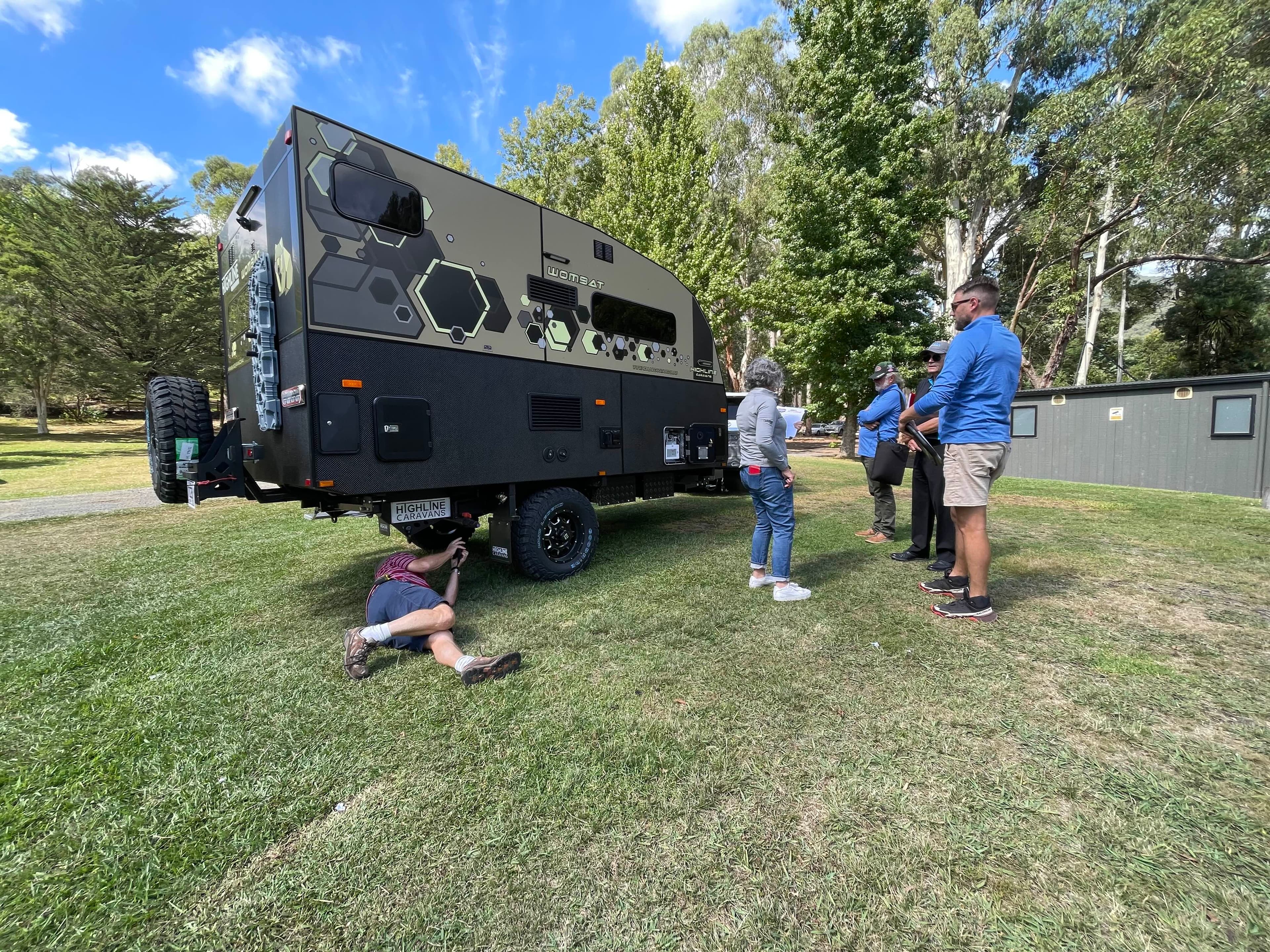
For a comprehensive breakdown — individual axle weights, tow ball mass, and specific compliance advice — Weigh Me RV offers mobile weighing and can advise on load redistribution if something's out.
As Michael Borg says: "There is much more to it than just your vehicle's towing capacity, so try and speak to an expert. Prevention is better than cure."
The Easy Way: VANTURE's Tow-Match Tool
Create your free account and save your tow vehicle once — make, model, year and ATM. VANTURE cross-references every listing's ATM against your vehicle's specifications and shows you instantly on every listing:
🟢 Safe to tow — ATM is comfortably within your vehicle's capacity
🟡 Close to limit — within capacity but worth checking your specific loaded payload
🔴 Exceeds capacity — this van will not be legal with your vehicle
You'll never waste an afternoon inspecting a van you can't legally tow. And when you find the right match, the full manufacturer spec — ATM, GTM, tare — is right there on the listing.
Add your tow vehicle and see compatible listings instantly →
Quick Reference: The 5 Limits
Term What it means Set by ATM Maximum loaded weight of the caravan, unhitched Caravan manufacturer GTM Weight on the caravan's axles when hitched Caravan manufacturer GVM Maximum loaded weight of the tow vehicle Vehicle manufacturer GCM Maximum combined weight of vehicle and caravan together Vehicle manufacturer TBM Maximum downward force on the tow ball Tow bar and vehicle manufacturer
Stay within all five simultaneously, every trip. If you're not sure, weigh it.
Next in the series: What Does a Caravan Road Trip Really Cost in 2026? →
Also in this series: Buying Your First Caravan → · Caravan Finance Explained → · How to Value Your Caravan →
Thinking of selling? Sell your caravan on VANTURE — free to list, same price whatever it's worth, and no commission ever.
List your caravan free