First-Time Caravan Buyer's Checklist: 27 Things to Do Before You Sign

Buying your first caravan is one of the largest discretionary purchases most Australian households ever make. The gap between a good decision and an expensive mistake is almost entirely determined by preparation — not price negotiation skills, not luck.
Daniel Sahlberg, CEO of Caravan Industry Victoria — the peak body representing 93% of Australia's caravan manufacturers — advises buyers to check industry association membership on the CIAV website as part of their due diligence. The collapse of Tango Caravans in 2024, which left dozens of buyers without their vans or deposits, was a stark reminder of what's at stake.
This checklist covers every stage: before you start shopping, what to check on any van you're seriously considering, the paperwork you must have, and how to sort finance and insurance without getting caught off-guard.
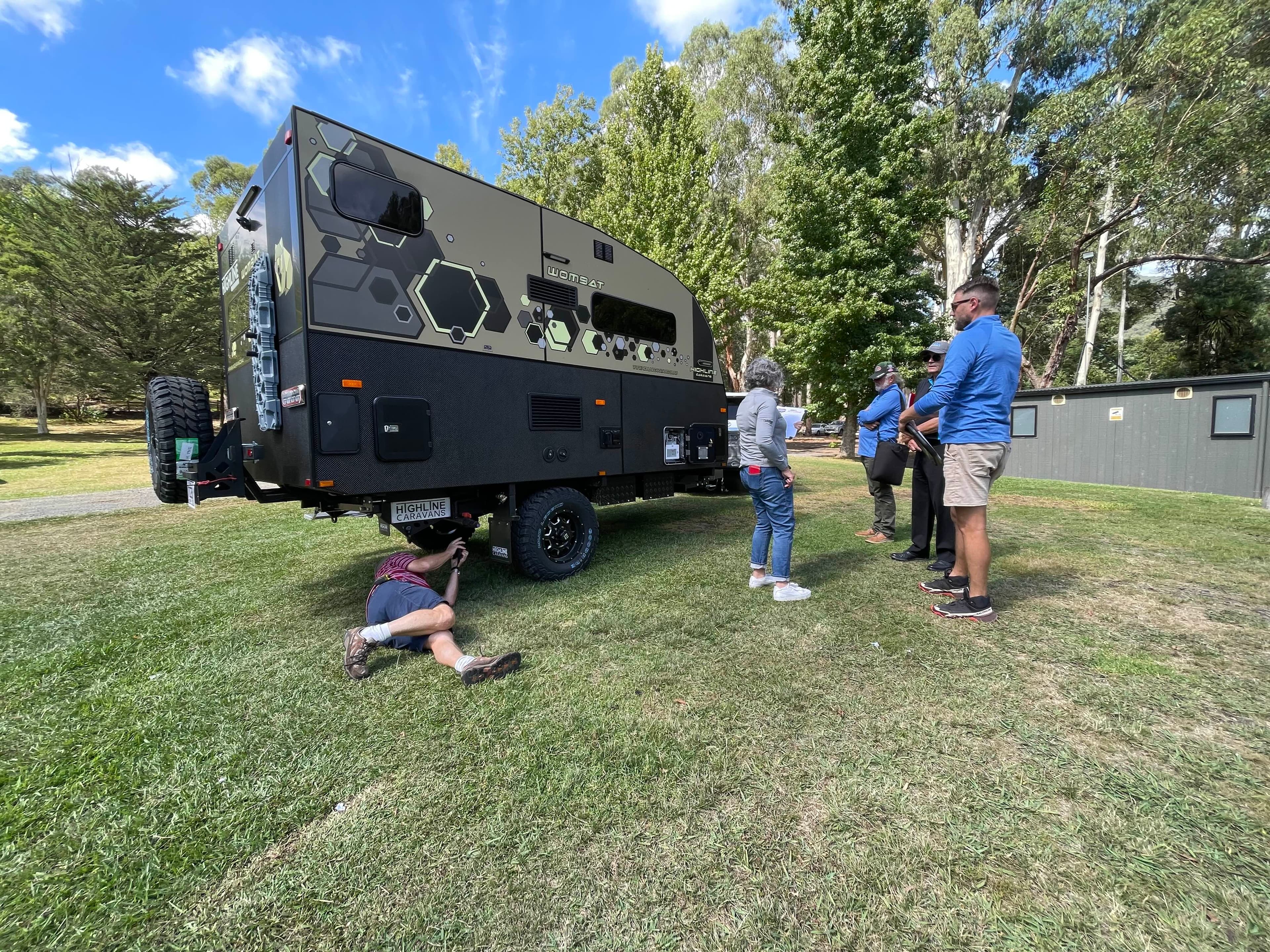
image credit (@Caravan World - Behind the scenes judging)

Before You Start Shopping: 7 Non-Negotiables
These decisions need to be made before you look at a single van — because they determine which vans are even on the table.
1. Confirm your tow vehicle's real, loaded towing capacity. Not the sticker figure. Your actual usable capacity once the car is loaded with passengers, fuel, accessories, and the tow ball mass of the van. See our complete towing weights guide.
2. Decide on your sleeping configuration. Island queen vs rear queen vs bunk room vs dinette conversion. This shapes the entire floor plan decision.
3. Choose your van category: on-road, hybrid, or off-road. These are genuinely different products. An on-road van taken regularly on dirt roads will shake itself apart. Our seasonal routes guide helps calibrate this.
4. Set a total budget — not just a purchase price. Van purchase + tow vehicle setup + insurance + first-year running costs. See our cost breakdown for the full picture.
5. Sort finance pre-approval before you negotiate. Walking in with pre-approval means you know exactly what you can spend and you're not at the mercy of dealer finance rates. Get pre-approved on VANTURE →
6. Measure your storage space. Your garage, driveway, or wherever you're keeping the van. Add a metre to the van's stated length for the tow hitch — the stated length doesn't include the A-frame and coupling.
7. Join at least one caravan community online. The common failure modes of specific van brands are well-documented in Facebook groups and forums. Use this intelligence before you buy.
New vs Used: The Honest Trade-Off
Buying new means warranty coverage (typically 12 months on parts and workmanship), no unknown history, and a van configured exactly how you want it. The downside is cost and delivery timelines that can run 3–6 months for popular models. You also absorb the steepest year of depreciation (typically 15–20%).
Buying used can save you $15,000–$40,000 against the equivalent new van. A well-maintained 2–3 year old van will have already taken that first depreciation hit. The risk is condition — which is why the inspection process below is non-negotiable.
Buying from a dealer vs private seller: Dealers offer consumer guarantees under Australian Consumer Law. Private sellers have less formal obligation — the due diligence burden on you is higher.
The 20-Point Physical Inspection Checklist
For a used van, consider paying for an independent pre-purchase inspection ($200–$400 from a qualified technician) — it's cheap insurance on a $50,000+ purchase.
Roof and External Structure
1. Check the roof for delamination. Press gently along the entire roof surface. Any soft or spongy areas indicate water ingress and delamination — expensive to fix.
2. Inspect all external seals and caulking. Run your finger along every join, window seal, door seal, and roof vent flashing. Cracked or missing sealant is the entry point for water damage.
3. Check every external locker and hatch. Open and close each one — they should open cleanly, seal properly, and show no signs of water pooling or rust inside.
Internal Structure
4. Check the floor throughout the van. Walk the entire floor and press down firmly in corners, near the door entry, and around the bathroom. Soft spots indicate water damage to the floor substrate.
5. Check under every mattress and inside every storage compartment for signs of moisture, mould, or musty smell.
6. Check cabinetry for swelling at the base of door panels. Water-damaged MDF swells noticeably at the bottom — it indicates a history of moisture ingress.
Mechanical and Compliance
7. Check the tyre condition — and the date codes. Look at the sidewall for the 4-digit manufacturing date code. Any tyre more than 7 years old should be replaced regardless of tread depth. This is a safety issue.
8. Test the brakes. If the van has electric brakes (required over 2,000 kg GTM), ask the seller to demonstrate the breakaway battery function.
9. Check the chassis for rust. Get under the van and look at the main chassis rails. Surface rust is common and manageable. Through-rust on structural members is serious.
10. Inspect the hitch and coupling. The coupling head should open and close smoothly with no play. The A-frame should show no cracking or repair welds.
11. Check wheel bearings. Grab each wheel at 9 and 3 o'clock and try to rock it. Any play or roughness indicates worn bearings — factor the service cost into your negotiation.
Systems
12. Test every 12V light and fitting. Switch on the 12V system and check every internal light, the water pump, and any 12V appliances.
13. Test the 240V system. Connect to a power source and test every power point.
14. Check the solar panels and battery. Check panel condition, the controller (should show a reading), and the battery voltage (healthy AGM battery at rest: above 12.4V).
15. Check the gas system. The gas compliance plate should be current (max 5 years). Gas appliances should ignite cleanly. Any smell of gas with appliances off — walk away.
16. Test the hot water system. Fill the water tank and run the hot water to verify it heats correctly.
17. Check the annex and any canvas. Unroll the awning and inspect for UV damage, mould, or tears. A new awning costs $300–$800.
Documentation
18. Request the full service history. A regularly serviced van has documented evidence of care.
19. Check the compliance plate. Located near the entry door. It shows ATM, GTM, and tare weight — verify these match what was advertised.
20. Verify that modifications are certified. Any significant modification should have appropriate documentation. Uncertified modifications can affect insurance coverage and compliance.
The PPSR Check: Non-Negotiable on Used Purchases
The Personal Property Securities Register (PPSR) records financial interests over personal property — including caravans. Running a PPSR check tells you whether the van has any registered finance against it, or has been reported stolen or written off.
Cost: $2 at ppsr.gov.au. You need the van's VIN or chassis number (on the compliance plate). Takes two minutes. If a PPSR check returns an encumbrance, do not complete the purchase until that debt is confirmed paid and the interest discharged.
There is no good reason to skip a PPSR check. Ever.
Finance and Insurance: Getting Both Right
Finance: VANTURE's embedded finance partner connects buyers with 30+ lenders and provides pre-approval in minutes with no credit score impact. Rates are shown directly on VANTURE listings. Don't assume your bank has the most competitive rate — specialist recreational vehicle lenders often have better-structured products. Apply here →
Caravan insurance: Most home insurance policies explicitly exclude caravans while travelling. You need a standalone caravan insurance policy. Budget $800–$2,500 per year depending on van value and cover level.
Contents insurance while caravanning: The personal belongings inside your van may not be covered by your home contents policy when travelling full-time. Check with your insurer and get written confirmation.
Check the Manufacturer's Industry Accreditation
Check whether the van's manufacturer is a member of the Caravan Industry Association of Australia (CIAA) and whether they hold RVMAP accreditation — the industry's independently audited quality and compliance standard. This matters most for new van purchases.
What VANTURE's Sold Prices Tell You Before You Negotiate
Before you make an offer on any van, check what comparable models have actually sold for — not asking price, sold price. VANTURE keeps every sold listing public with the real sale price. Walking into a negotiation knowing what the last three comparable vans sold for is the most useful advantage a private buyer can have.
Check sold prices on VANTURE →
10 Questions to Ask Every Seller
"Can I see the full service history?"
"Has the van ever had water ingress, and if so, what was repaired?"
"What is the current tare weight and has anything been added since manufacture?"
"Is the gas compliance certificate current, and when was it last inspected?"
"Have the wheel bearings been repacked in the last 12 months or 10,000 km?"
"Are there any known electrical faults or systems that aren't working?"
"Has the van been in an accident or had any structural repairs?"
"Are there any finance encumbrances on the van?" (Then run the PPSR check regardless.)
"Is the warranty still current and transferable?" (For near-new vans.)
"Will you allow an independent pre-purchase inspection before we finalise?"
A seller who becomes evasive on any of these questions is giving you useful information.
Ready to Start Looking?
VANTURE gives you Australia's most complete caravan and motorhome search — with tow compatibility shown per listing, real sold prices, ID-verified sellers, and finance pre-approval embedded directly into every listing page.
Browse listings on VANTURE →
Get pre-approved for finance →
Next in the series: How to Sell Your Caravan in Australia →
Also in this series:
Thinking of selling? Sell your caravan on VANTURE — free to list, same price whatever it's worth, and no commission ever.
List your caravan free