Can a Toyota HiLux Tow a 3,500 kg Caravan? The Reality Check, Using Toyota's Own Numbers

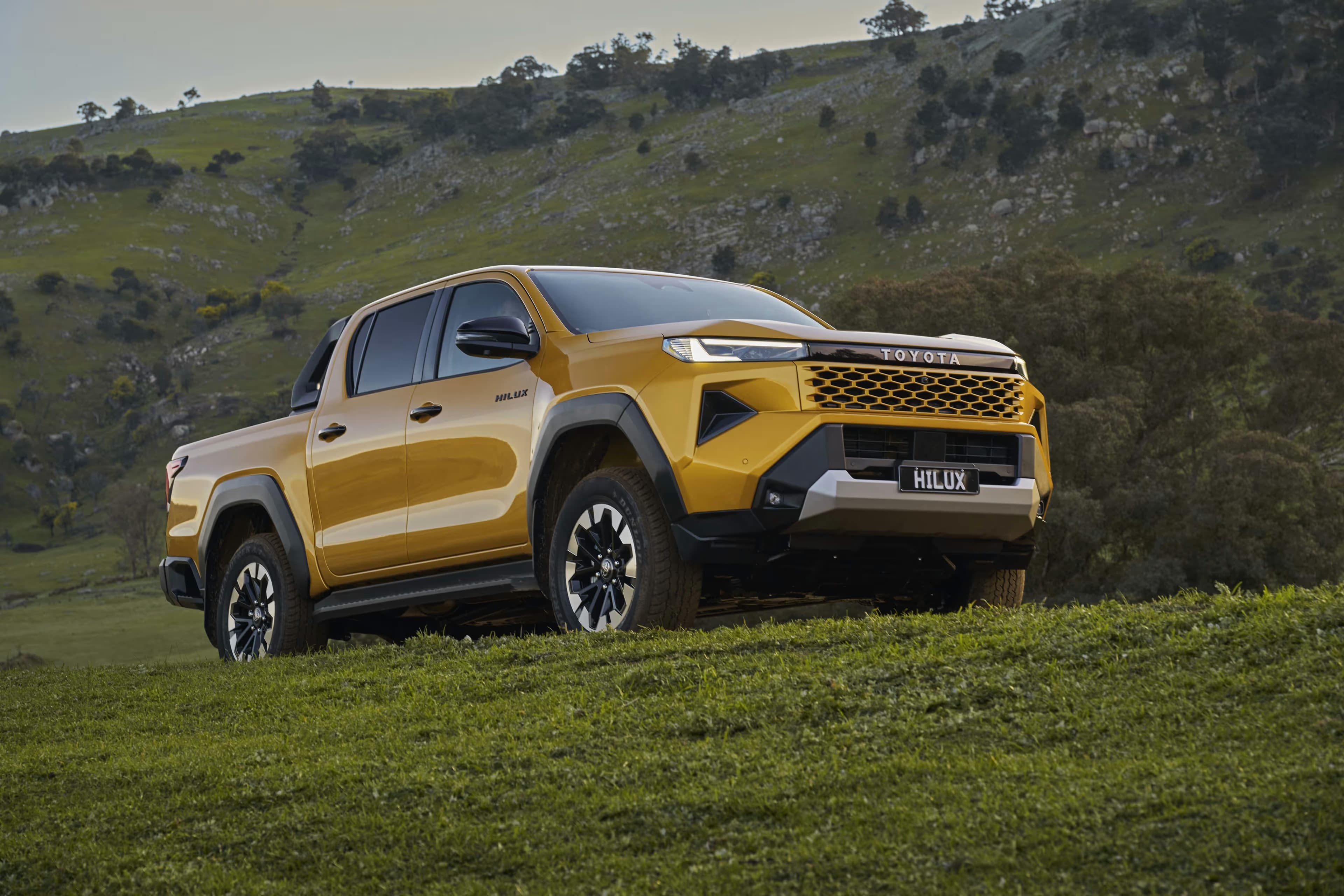
The HiLux has towed more Australian caravans than almost anything else on the road, and it has earned that. It is the ute people buy when they want something that will still start on the fourth morning of a dirt road. So the question at every caravan show — "will the HiLux pull a 3.5-tonne van?" — deserves a straight answer rather than a shrug.
Toyota rates every 4x4 HiLux to tow 3,500 kg with trailer brakes. That part is simple. What decides whether your HiLux, with your passengers and your gear, can legally tow that van is a second number that gets far less attention: Gross Combination Mass.
This is the third in our model-by-model series of towing reality checks. The Toyota Prado came first, then the Ford Ranger. Same method, different vehicle — and this time the finding is sharper than either.

Every figure below comes from Toyota Australia's own published HiLux specification sheets (the June 2026 diesel sheet and the May 2026 battery-electric sheet), paired with what caravans currently listed on VANTURE actually weigh. Nothing here is lifted from a forum, a video, or a bloke at the weighbridge.
The four numbers that decide it
If you only remember four terms, make it these. There's a fuller explanation in our ATM, GTM and Tare guide, but in short:
Kerb weight — what the ute weighs empty, before you or your gear get in.
GVM (Gross Vehicle Mass) — the most the ute is allowed to weigh, fully loaded, on its own wheels.
GCM (Gross Combination Mass) — the most the ute and the van are allowed to weigh together.
ATM (Aggregate Trailer Mass) — the most the van is allowed to weigh, fully loaded, including what presses down on the tow ball.
Toyota spells out the same point in its own footnote on the spec sheet, and it is worth reading twice:
"Actual payload is affected by any added load to the vehicle, including the number of occupants, luggage, accessories, and tow ball download weight."
That last clause is the one that catches people. The weight the van's drawbar puts on your tow ball doesn't belong to the van any more — it sits on the ute, inside the ute's GVM.
Toyota's published HiLux numbers
Here is what Toyota Australia states in the HiLux specification sheet dated June 2026 (document GTO-010060-00), for the 4x4 diesel range:
Figure | Toyota's published value (4x4 diesel) |
|---|---|
Braked towing capacity | 3,500 kg — every 4x4 variant |
Gross Combination Mass (GCM) | 6,300 kg — every 4x4 variant, without exception |
GVM, standard | 3,065 – 3,120 kg, depending on grade |
GVM with the factory GVM Upgrade option | 3,500 kg, on selected 4x4 variants |
Maximum kerb weight, automatic | 1,830 kg (WorkMate single-cab cab-chassis) up to 2,342 kg (Rogue) |
Maximum kerb weight, manual | 2,000 – 2,130 kg |
Unbraked towing capacity | 750 kg |
Two things jump out of that table.
The first is that GCM is 6,300 kg on every single 4x4 column — WorkMate through Rugged X, manual or automatic, cab-chassis or pick-up, with or without the GVM upgrade. Toyota has set one combination limit for the whole 4x4 range.
The second is the 512 kg spread in kerb weight between the lightest and heaviest 4x4 HiLux. Every one of them is "rated to tow 3.5 tonnes." They are not the same tow vehicle.
The one piece of arithmetic worth memorising
Here is the sentence that answers the question:
On a 4x4 HiLux towing a 3,500 kg van, GCM caps the fully loaded ute at 2,800 kg. Full stop.
That's just 6,300 minus 3,500. And it works cleanly because the tow ball download is already counted inside the van's ATM — so GCM, minus the van's ATM, minus the ute's kerb weight, is what's left for people, luggage and accessories. No double-counting required.
Run it across the range:
HiLux 4x4 | Kerb weight | What's left at a 3,500 kg van |
|---|---|---|
WorkMate single-cab cab-chassis (auto) | 1,830 kg | 885 kg — before a tray is fitted |
Rugged X double-cab pick-up | 2,327 kg | 443 kg |
Rogue double-cab pick-up | 2,342 kg | 428 kg |
(The WorkMate and Rugged X/Rogue figures are the tighter of the two tests — GVM or GCM — at a 350 kg tow ball download. Working shown below.)
A 457 kg spread, across vehicles that all wear the same 3,500 kg tow rating. That is the finding, and it is the same lesson the Ranger taught us, only louder: which HiLux changes the answer far more than whether it's a HiLux.
Where each number comes from
Take the Rogue, the heaviest of the range. Kerb 2,342 kg, GVM 3,120 kg, GCM 6,300 kg.
The GVM test. Payload is GVM minus kerb: 3,120 − 2,342 = 778 kg. A 3,500 kg van at a typical 10% tow ball download puts 350 kg of that straight onto the ute. 778 − 350 = 428 kg left for people, gear and accessories.
The GCM test. 6,300 − 2,342 − 3,500 = 458 kg.
GVM is the tighter of the two, so 428 kg is the honest answer. Two adults account for roughly 160 kg of that. A bullbar and a set of drawers can eat most of what remains.
Now the WorkMate single-cab cab-chassis at 1,830 kg kerb: the GVM test gives 3,065 − 1,830 − 350 = 885 kg, the GCM test gives 970 kg, so 885 kg stands — but a cab-chassis needs a tray, and Toyota's sheet lists its dimensions as "dependent on tray being fitted." Whatever the tray weighs comes off that 885 kg before you load a thing.
The GVM upgrade finding
This is the part almost nobody is told, and it comes straight out of Toyota's own table rather than from anyone's opinion.
Toyota offers a factory GVM Upgrade option that lifts GVM to 3,500 kg on selected 4x4 variants. On the same page, in the same table, GCM stays at 6,300 kg — for the upgraded columns exactly as for the standard ones.
So a GVM upgrade genuinely helps: it gives the ute more room to carry weight on its own axles, which matters for accessories, canopies and heavy tow ball downloads. What it does not do is add capacity to the combination. At a 3,500 kg van, the loaded ute is still capped at 2,800 kg by GCM, whatever the GVM plate says.
What the upgrade really does is change which limit stops you first:
With standard GVM of 3,120 kg, GVM is the binding limit at every van weight up to the 3,500 kg tow cap.
With the GVM upgrade to 3,500 kg, GCM takes over as the binding limit once the van's ATM passes roughly 3,111 kg.
If a salesperson tells you a GVM upgrade "sorts out the 3.5-tonne question," that's a well-meant shortcut rather than the whole picture. It's worth having — just for the right reason.
Not sure what your van actually weighs, or what your car can legally pull? VANTURE has a free tow-compatibility check that works from real published vehicle figures. Read how it works, or start with our full GVM, GCM and ATM guide.
The 4x2 is a different vehicle again
Worth saying plainly, because the badge on the tailgate looks identical. Toyota's June 2026 sheet gives the 4x2 HiLux a braked towing capacity of 2,900 kg and a GCM of 5,800 – 5,880 kg.
A 4x2 HiLux is a fine tow vehicle for a camper trailer or a smaller van. It is not a 3.5-tonne tow vehicle, and Toyota doesn't claim it is.
And the battery-electric HiLux is different again
Toyota now publishes a separate specification sheet for the battery-electric HiLux (document GTO-009923, May 2026), and the towing figures are their own story:
Figure | HiLux BEV |
|---|---|
Braked towing capacity | 2,000 kg |
Gross Combination Mass | 4,670 kg |
GVM | 3,135 – 3,170 kg |
Maximum kerb weight | 2,280 – 2,455 kg |
Take the SR5 BEV pick-up at 2,455 kg kerb. Towing a 2,000 kg van, GCM leaves 4,670 − 2,455 − 2,000 = 215 kg for people and gear. That is two adults and very little else.
Turn it around and it's more useful: load 400 kg of people and gear into that SR5 BEV, and GCM leaves about 1,815 kg for the van. So the electric HiLux is realistically a camper-trailer and small-van tow vehicle. It is not being sold as anything else — Toyota publishes the 2,000 kg rating clearly on the front page of its own spec sheet. It is simply a different tool for a different job, and worth knowing before you fall in love with a 20-footer.
What Australian caravans actually weigh
Numbers on a spec sheet only matter against real vans. Here is what the 415 caravans, motorhomes and camper trailers listed on VANTURE on 8 September 2026 look like — 293 of them state an ATM:
ATM band | Listings | Share |
|---|---|---|
Up to 2,000 kg | 60 | 20.5% |
Up to 2,500 kg | 111 | 37.9% |
Up to 3,000 kg | 191 | 65.2% |
Up to 3,500 kg | 278 | 94.9% |
Over 3,500 kg | 15 | 5.1% |
Median ATM: 2,800 kg.
The headline is genuinely reassuring: a 4x4 HiLux is rated to tow roughly 95% of what's currently on the market. The 3.5-tonne question, for most buyers, is not the question they should be asking.
The band that deserves care is the 3,001 – 3,500 kg group — 87 listings, 29.7% of everything with a stated ATM, median asking price $69,250, and 40 of them flagged off-road. Off-road-flagged vans run heavier across the board: their median ATM is 3,000 kg against 2,640 kg for everything else. If the van you love is a big off-roader, this is where the sums start to matter.
At the market median of 2,800 kg, a HiLux Rogue has 778 − 280 = 498 kg for people, gear and accessories. Two adults, a full water tank in the ute, and a reasonable kit — that works, comfortably.
At the top of the range it tightens fast. That's not a HiLux problem; it's arithmetic that applies to every dual-cab ute in the country.
Five minutes that will settle it for your own vehicle
Don't take our figures, or anyone's. Take yours.
Read your own compliance plate. Kerb weight, GVM and GCM vary by model year, grade and drivetrain. Toyota's own footnote says weights "are approximate and subject to individual vehicle variances, and should be confirmed before fitting any accessories, towing or otherwise relying on this value." Your build plate and Owner's Manual beat any brochure, including this article.
Subtract the van's ATM from your GCM. That's the most your fully loaded ute may weigh.
Subtract your kerb weight from that. That's your people-and-gear budget on the GCM test.
Run the GVM test too. GVM minus kerb minus the tow ball download. Take whichever answer is smaller.
Then go and weigh it. A public weighbridge is the only thing that tells you the truth about your actual ute with your actual gear in it. VANTURE's inspection and weighing services directory will find someone local, and our suspension, tyres and brakes guide covers what those axle numbers mean once you have them.
Two practical notes while you're at it. Toyota's spec sheet lists "Towbar (receiver only)" and "Tongue and tow ball (required for towing)" as separate line items — so on some grades the receiver is fitted at the factory and the tongue and ball are not. Check what's actually bolted to your car. And Toyota does not publish a maximum tow ball download figure on the spec sheet; it points owners to the Owner's Manual and the Toyota Basic Towing Guide, so that's where we'll point you too rather than guess.
The honest answer
Yes — a 4x4 HiLux will tow a 3,500 kg caravan, and Toyota rates every one of them to do it.
Whether your HiLux can tow that van, with your family and your gear in it, comes down to a subtraction you can do at the kitchen table in five minutes. On the heaviest grades you have somewhere near 430 kg to play with at the top of the tow range. On the lightest you have nearly 900 kg. Both are HiLuxes.
The good news, which gets lost in the 3.5-tonne argument: 95% of the vans on the market right now sit inside a 4x4 HiLux's rating, and at the market median you have comfortable room. The question worth asking isn't "can it tow 3.5 tonnes?" It's "what does the van I actually want weigh, and what's left for me?"
Ready to look at vans that suit your vehicle? Browse caravans, motorhomes and camper trailers on VANTURE — every listing shows its ATM where the seller has provided it, so you can check the sums before you drive anywhere.
Also in this series
Thinking of selling? Sell your caravan on VANTURE — free to list, same price whatever it's worth, and no commission ever.
List your caravan free