Caravan Suspension, Tyres and Brakes: The Australian Owner’s Technical Guide

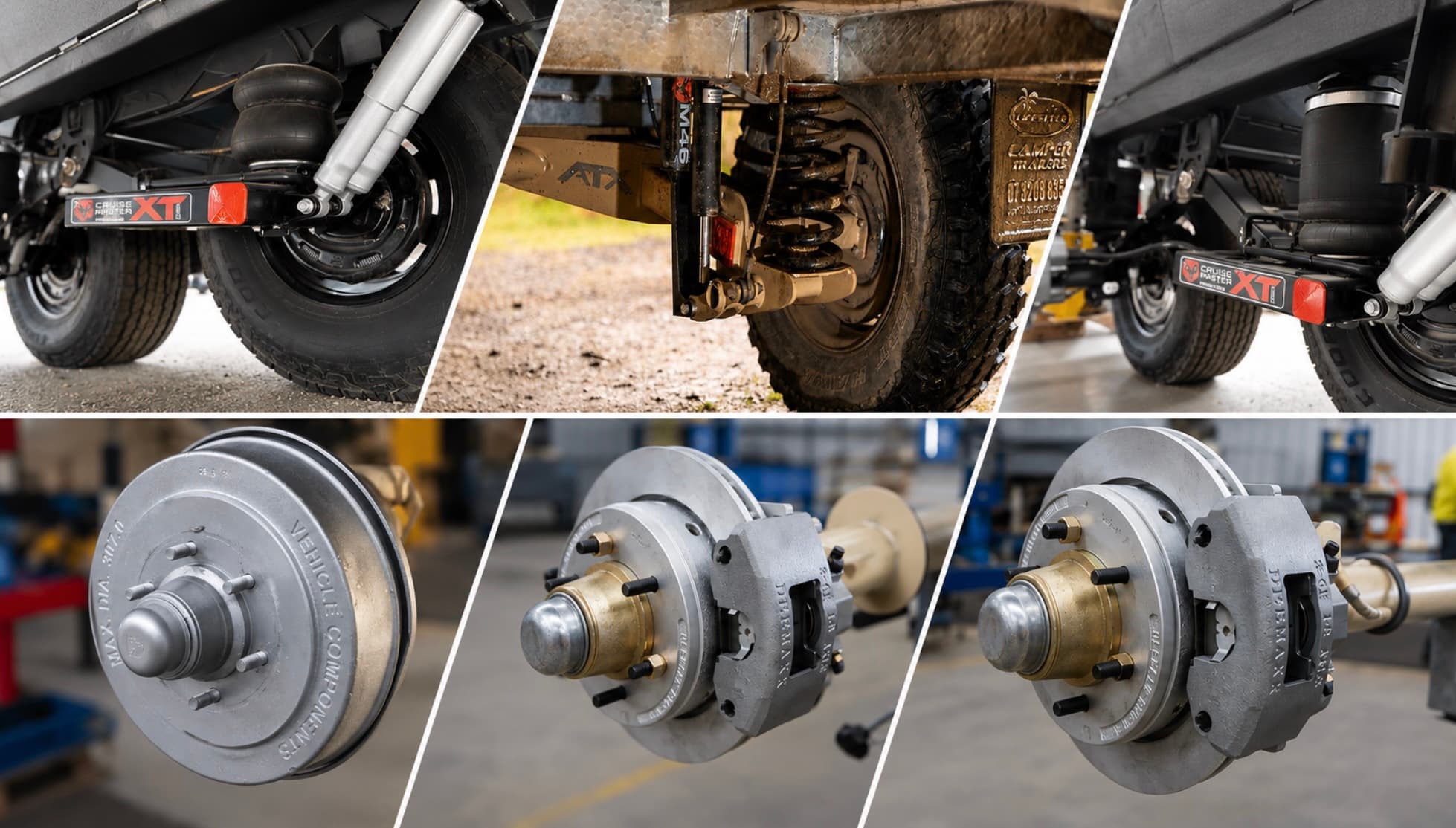
Nobody buys a caravan because of its brakes.
People buy the layout. The island bed, the ensuite, the kitchen that finally has bench space. Then they spend the next ten years being carried and stopped by three systems they never looked at — the suspension, the tyres and the brakes — and those three are the only reason the layout ever arrives anywhere.
This is a guide to those systems: what the Australian rules actually require, what they conspicuously don't, and what that means when you're standing in front of a van with money in your pocket.

We'll be upfront about the shape of the answer, because it's the most useful thing in this article. The rules do far less than most buyers assume. They set a floor for how a van is built. They have almost nothing to say about whether a particular van suits a particular road. That gap is not a scandal — it's just the space where your judgement has to do the work, and it helps enormously to know exactly where it starts.
The one number that catches everybody: GTM, not ATM
Start here, because getting this backwards will make everything downstream wrong.
Australia's braking rules for caravans and trailers are set out in Vehicle Standards Bulletin 1 — the national code for trailers up to 4.5 tonnes. And VSB 1 is unusually direct about this, in a highlighted box:
"Braking requirements are specified in terms of Gross Trailer Mass (GTM) not Aggregate Trailer Mass (ATM)."
They are not the same number, and the difference is the weight on your tow ball.
ATM is the whole van at maximum load, including what presses down on the car. GTM is only what reaches the ground through the van's own wheels. So ATM minus GTM equals the tow ball down-weight — which means GTM is always the smaller figure, by a couple of hundred kilos on a typical van.
Why it matters: a van at 2,000kg ATM with 180kg on the ball has a GTM of about 1,820kg. Read the rules with the ATM in your hand and you'd think it sits above the 2,000kg line. Read them properly, with GTM, and it sits below — on the other side of the "brakes on all wheels" threshold.
Both numbers are on the compliance plate. Use the right one. And one more thing worth knowing, straight from VSB 1: "both ATM and GTM are manufacturer-specified ratings – that is, they cannot be measured on a weigh-bridge." They're ratings, not weights. A weighbridge tells you what your van actually weighs, which is a different and equally important question.
Our complete GVM, GCM and ATM guide is the full treatment of the weights alphabet if you want it.
Brakes: what the rules actually require
Here's the ladder, in GTM, from VSB 1:
Up to 750kg GTM, single axle: no brakes required.
Over 750kg GTM, or more than one axle: an efficient service braking system is required. Except for over-run brakes, it must be activated by a control signal generated by the tow vehicle.
Up to 2,000kg GTM: brakes may be fitted to one axle only, and over-run brakes are permitted.
Over 2,000kg GTM: brakes must operate on all wheels, and the van must have an efficient emergency braking system — a breakaway system. It must apply the brakes immediately if the van comes off the car, and the brakes must stay applied for at least 15 minutes.
That fifteen minutes is worth sitting with. It's not a token gesture. It's the length of time the standard thinks a runaway van needs to be held still — and it's why the breakaway battery is not an optional accessory you can let go flat. A breakaway system with a dead battery is a decoration.
Note the axle detail: two axles with centres less than one metre apart are treated as a single axle for these purposes.
What "efficient" means
VSB 1 defines an efficient service brake as one that:
has sufficient capacity to achieve 0.45g deceleration of the trailer
can dissipate the heat generated by multiple brake applications
can be adjusted and balanced so each wheel does its appropriate share
effectively varies the stopping force based on how hard the tow vehicle is stopping
Read that list again, because it's a better buying guide than most buying guides. Heat dissipation and balance are in the legal definition of a working brake. Not as niceties — as part of what the word means. Anyone who has smelled their own brakes coming down a long descent has met that clause personally.
Drum or disc?
The question everyone asks, and we're not going to hand you a verdict, because there isn't an honest one that applies to every van and every trip.
What's fair to say: drums are enclosed, which cuts both ways — sealed away from mud and dust, but also holding heat and harder to inspect without pulling them apart. Discs shed heat and water more readily and are easier to look at, but they're exposed to whatever the road throws at them, and they generally cost more.
Both are legal. Both stop caravans across Australia every day. Australian suspension and brake manufacturers have made genuinely good arguments in both directions, and the sensible reading is that they're optimising for different customers — not that one camp is right.
The useful question isn't "drum or disc?" It's "does this braking system suit the descents and the weight I'll actually be in, and can I get it serviced where I travel?" A brake you can't get parts for in Katherine is a different proposition from one you can.
One honest caveat. VSB 1's braking chapter carries a note in the document itself saying the content is currently under review, and VSB 1 defers to the Australian Design Rules where the two disagree. The figures here are what the published bulletin says today. If a decision turns on a threshold, check it's still current.
Suspension: where the rules go quiet
This is the section that surprises people.
VSB 1 has remarkably little to say about caravan suspension. It requires:
Load-sharing. All axles in a group must be interconnected by load-sharing suspension — designed so each axle carries the same load regardless of the relative movement of the wheels. There are exceptions for closely-spaced axles (two axles with centres not more than 1,000mm apart, three within 2,000mm, four or more within 3,200mm).
The 120% rule for close-coupled axles. Where non-load-sharing suspension is used in close-coupled axles, VSB 1 requires that "the individual axles, and the wheels and tyres fitted to each axle, must have a load carrying capacity at least 120% of the load on that axle with the trailer at its ATM." Note that this one is expressed in ATM, not GTM — the standard genuinely does switch units between chapters, which is exactly why the earlier section matters.
Running clearance of 100mm or greater — measured to the lowest point of the unladen van, excluding parts not supported by the suspension.
And that is very nearly the lot.
There is no general axle rating requirement in VSB 1 — no rule that the sum of your axle ratings must exceed your GTM, no minimum margin. The 120% figure is the only axle capacity number in the document, and it applies solely to non-load-sharing close-coupled groups. There are no suspension design requirements beyond load-sharing — nothing about leaf versus independent, nothing about shock absorbers, nothing about what "off-road" suspension has to be.
This is the single most useful thing in this article, so let's say it plainly: the standard does not tell you whether a van's suspension suits corrugations. It was never trying to. VSB 1 is a manufacturing standard — it tells a builder what a trailer must be to be legally sold. Whether that trailer will survive the Gibb River Road is a product question, and the market answers it, not the rulebook.
So when a van is advertised with heavy-duty independent suspension, that's not a compliance claim. It's a design claim, and a real one — but the badge on the brochure isn't doing the work. Ask what the components are rated to, ask what the warranty says about unsealed roads, and ask specifically whether corrugations are covered. The warranty is often the most honest document in the whole transaction, because it's the one the manufacturer has to stand behind with money.
Leaf or independent?
Same answer as drum-or-disc: it depends, and anyone who tells you otherwise is selling something.
Leaf springs are simple, cheap, tough, repairable in a country town by someone who's seen a hundred of them, and they've carried Australian trailers for a very long time. Independent suspension generally rides better, keeps wheels planted more consistently over rough ground, and is more complex and more expensive to buy and fix.
For sealed roads and good gravel, well-specified leaf springs are entirely adequate and always have been — plenty of people are talked out of them for trips that would never have troubled them. For sustained corrugations, the case for independent gets stronger. But a well-engineered leaf setup beats a poorly-matched independent one, every time, and the quality of the specific installation matters more than the category it belongs to.
Compare real vans, with the manufacturer's specifications on every listing. Browse caravans and motorhomes on VANTURE
Tyres: the shortest chapter in the rulebook, and the biggest surprise
VSB 1's entire requirement for tyres is that they be "of suitable specifications for the trailer's intended use" — specifically size, speed rating and load rating — and that wheels and tyres comply with the applicable Australian Design Rules.
There's also a placard rule: vans with a GTM not exceeding 3,500kg must carry a tyre placard showing the manufacturer's recommended tyre size, load rating, speed rating and cold inflation pressure. Go and find yours. It's the manufacturer telling you, in writing, what they designed the van to run on — and it's the single most-ignored sticker on any caravan.
Now the part that catches people out.
VSB 1 says nothing whatsoever about tyre age. No maximum age. No date-code rule. No replacement interval. We looked through the whole document; the only "dates" in it concern the trailer's own manufacture and the production code on couplings. Neither is about tyres.
And more broadly: in Australia there is currently no legal requirement to replace tyres by a particular date. Roadworthiness turns on condition and tread, not birthdays.
This matters because "tyres must be replaced at seven years" gets repeated as though it were law, and it isn't. But — and this is the important half — that it isn't law doesn't make it bad advice. Rubber ages whether or not it's being used, and a caravan tyre is the worst case for it: often parked for months, often in the sun, often carrying near its limit when it finally does work, often a long way from help. A caravan tyre can have beautiful tread and still be too old to trust, because tread depth measures wear and tells you nothing about age.
So here's the honest position, which is more useful than a number we can't source:
Find the date code. It's on the sidewall — the last four digits of the DOT code are the week and year of manufacture. "0619" means the sixth week of 2019. Do this on any used van you're considering, and on your own van today. It takes a minute.
Get older tyres professionally inspected. Tyre manufacturers publish their own age guidance and it varies between them, so the figure that applies to your tyres is the one from the company that made them — not a rule of thumb from a forum, or from us. What's consistent across the industry is that ageing tyres should be inspected by a qualified tyre professional, and that there comes a point where age alone is reason enough to replace.
Check the load rating against the placard. The tyres fitted are not always the tyres specified. Free to check, worth checking on any used van.
And check the spare. It's been on the back of the van since the day it was built, unloved, in the weather. It is very often the oldest tyre you own, and it's the one you'll need on the worst day.
The three checks worth doing before you buy
Not a full inspection — our 27-point first-time buyer's checklist covers the whole van. These are the three specific to running gear.
1. Read the compliance plate and the tyre placard together, then look at what's actually fitted. The plate gives you ATM, GTM and tare; the placard gives you what the tyres should be. Any gap between those documents and the physical van is a conversation — not necessarily a problem, but one to have before you buy rather than after.
2. Check the date codes on all five tyres. Including the spare. Thirty seconds, no tools, no expertise.
3. Ask when the brakes and bearings were last serviced, and whether the breakaway battery holds charge. A seller with service records is telling you something good. A seller without them isn't necessarily hiding anything — but you're buying an unknown, and it should be priced like one.
Beyond that, get a qualified inspector or a caravan service business to look at it. Suspension, brakes and bearings are exactly the systems where a professional sees in ten minutes what an enthusiastic buyer misses in an hour.
Find a service business near you. VANTURE's services directory lists caravan and motorhome businesses across Australia — suspension and brake specialists, tyre fitters and mobile mechanics. Find a service provider on VANTURE · How the services directory works
One more thing about what the rules cover
Worth saying clearly, because it explains a lot of confusion.
VSB 1 is about building and supplying new trailers. It tells manufacturers and importers what a trailer must be to enter the market legally. It explicitly does not cover registration, and it does not cover your obligations for a van that's already on the road. Those in-service rules — roadworthiness, what your state's inspector looks at — sit with your state or territory, and they aren't identical everywhere.
So a van can have been perfectly compliant on the day it was built and still need work today. Nothing has gone wrong; that's just the difference between a manufacturing standard and a maintenance obligation. The rules make sure the van left the factory right. Keeping it right is yours.
That's not a burden so much as a clarification. The three systems in this article are the ones that carry you and stop you, and they're also the three that quietly degrade while you're looking at the layout. Ten minutes with a date code, a compliance plate and a placard puts you ahead of most buyers on the lot — and it costs nothing but the ten minutes.
Ready to look? Compare real caravans and motorhomes at real prices, with the manufacturer's specifications on every listing. Browse all listings on VANTURE
Also in this series
Thinking of selling? Sell your caravan on VANTURE — free to list, same price whatever it's worth, and no commission ever.
List your caravan free