Where Will You Park It? Caravan Storage Costs, Council Rules and Driveway Reality

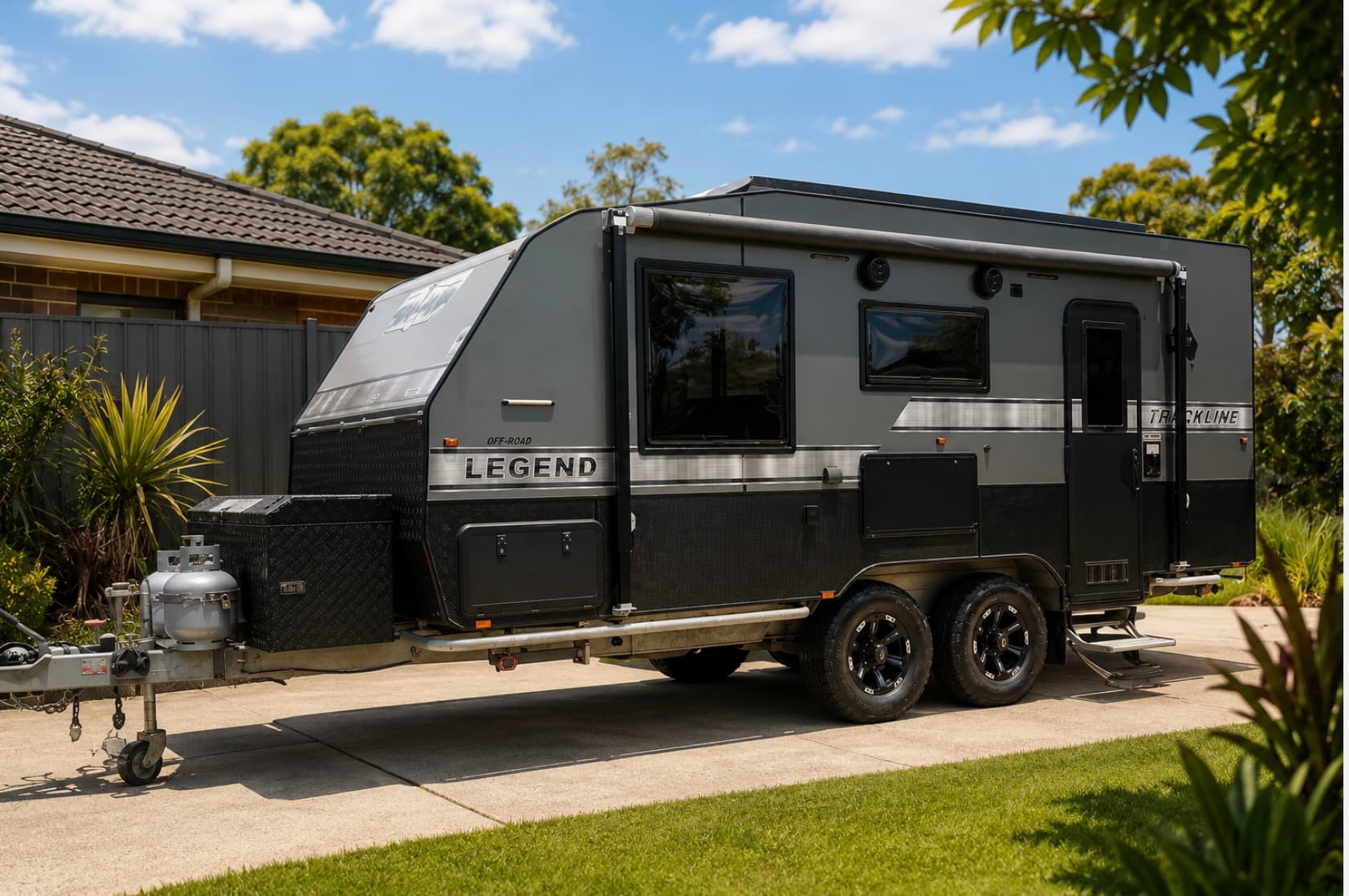
Here is the question that catches out more first-time buyers than any other: not "which caravan?" but "where is it going to live when we are not using it?"
It sounds like a detail. It is not. A caravan spends far more of its life parked than on the road, and where and how you store it affects your council, your neighbours, your insurance, and how well the van holds up over the years. Plenty of people fall in love with a van, sign the paperwork, and only then discover it does not fit down the side of the house — or that the body corporate will not have it on the property at all.
Let us sort it out properly, before it becomes a problem in your driveway.

Option one: keep it at home
The cheapest storage is your own place, and for most people it is the goal. But "at home" has more fine print than you would think.
The driveway or side of the house. Measure before you buy, not after. A caravan needs width to get past the gate, height to clear the eaves and any tree branches, and length to sit without hanging over the footpath. It also needs to not permanently block the car you actually drive every day. Reversing a van into a tight side space is a skill, and a tight space you can only just manage in summer is a genuine headache in the dark and rain.
The backyard. More private and more secure, but only if you have side access wide enough — and level enough — to get the van through. Many suburban blocks simply do not, and knocking out a fence or a garden bed to make one is a bigger project than the van.
Neighbours and the street view. Even on your own land, some councils have rules about caravans being visible from the street or parked forward of the building line. And a van that lives half on the nature strip is a common source of neighbour friction and council letters. Which brings us to the part everyone forgets to check.
The bit people skip: council and strata rules
This is the trap, so read this section twice.
Councils across Australia restrict parking a caravan on the street. The exact rules vary enormously from council to council, but many limit how long a trailer or caravan can stay parked on a public road or nature strip before it must be moved — and some prohibit it outright in certain zones. "It has always been fine" is not the same as "it is allowed." A quick call or search of your local council's rules before you buy is worth an hour of your time.
If you live in a unit, townhouse or anything strata-titled, check the by-laws first. Many owners' corporations do not allow caravans to be parked on common property or even in your own space where they are visible. This one has ended plenty of caravan dreams after the purchase rather than before. Do not assume — read the by-laws or ask the strata manager.
Councils and strata schemes each set their own rules, so we cannot tell you what yours says — only that you should find out before the van arrives, not after a notice turns up on the windscreen.
Option two: paid storage
If home storage is out — no space, no access, or the rules say no — paid storage is the normal answer, and there is a whole industry for it. It generally comes in three tiers:
Open-air / open yard. A fenced compound where the van sits outside on gravel or bitumen. The cheapest option, and fine for many people, but the van is exposed to sun and weather.
Undercover. A roof over the top, open or partly open on the sides. More protection from UV and rain for a middle price.
Fully enclosed / indoor. An individual lock-up or shed. The most protection and the most secure, and the dearest.
We are not going to quote you weekly prices, because they swing wildly by city, suburb and tier, and any figure would be out of date by the time you read it. The useful thing to know is the shape of the cost: open-air is cheapest, enclosed is dearest, and city-fringe facilities usually cost less than inner-suburban ones. Get a couple of quotes near you, and weigh the price against two things that are easy to underrate — how far the facility is from home (a van you have to drive an hour to collect gets used less), and how secure it is.
Looking for somewhere to keep it? Browse caravan and motorhome storage providers near you on the VANTURE Services directory — open-yard, undercover and enclosed options in one place.
Storage and your insurance
Where you keep the van can change what you pay to insure it, and even whether a claim is paid. Many insurers ask how and where a caravan is stored, and some offer better terms — or require — secure storage. If you tell your insurer the van lives in a locked compound and it is actually on the street, that mismatch can bite at claim time. Keep the two honest and aligned, and ask your insurer whether secure storage changes your premium; sometimes it more than pays for itself.
How to store a van so it lasts
Where the van lives matters; so does how you leave it. A caravan that is simply parked and forgotten for months deteriorates faster than one that is put away with a little care. The essentials:
Get it out of the sun if you can. Ultraviolet light is hard on everything — the roof membrane, the seals, the tyres, the decals. Undercover storage or a quality breathable cover slows all of that down. Avoid cheap plastic tarps that trap moisture and flap against the paint.
Look after the tyres. Tyres sitting in one spot for months can develop flat spots, and sunlight ages the rubber. Keep them inflated, off wet ground if possible, and covered from direct sun.
Manage the battery. A house battery left connected slowly drains and can be damaged by sitting flat. Depending on your setup, that means a trickle charge, a solar top-up, or disconnecting it — check what your van needs.
Keep it dry and ventilated inside. Shut up tight with no airflow, a van grows mould and musty smells. Leave a roof vent cracked if it is secure to do so, use moisture absorbers, and make sure the water system is drained if you are storing it over a cold or long period.
Chock it, and think about pests. Wheel chocks stop any movement, and a few simple steps keep mice and insects from turning your van into a home while you are away.
None of this is hard. Ten minutes of putting the van away properly saves you a very bad surprise the day before your next trip.
Convenience is a cost too
One factor people underweight when comparing home storage, a cheap yard on the edge of town, and a pricier facility close by: how easy it is to actually get to the van. A caravan that lives at home, or five minutes away, gets hitched up for a spur-of-the-moment weekend. A van stored an hour away, behind a gate that is only open business hours, quietly becomes a van you use twice a year. The whole point of owning one is spontaneity, and distance is the enemy of it. When you weigh a cheaper faraway option against a dearer close one, factor in the trips you will not take because collecting the van is a chore. Sometimes the more expensive spot is the one that actually gets used — and a van that gets used is worth far more than a bargain that sits idle.
The honest summary
Before you buy, answer three questions in this order. Where will it live? — home if you have the space and access, paid storage if you do not. Is that actually allowed? — check your council, and your strata by-laws if you are in a unit or townhouse, before the van arrives. How will I look after it there? — out of the sun, tyres and battery managed, dry inside.
Sort those three and the van is a joy every time you hitch up. Skip them and you are the person moving a caravan up and down the street every second Tuesday, wondering why the seals have gone chalky. A little planning now buys years of easy weekends later — which is the whole point of the thing.
Also in this series
Thinking of selling? Sell your caravan on VANTURE — free to list, same price whatever it's worth, and no commission ever.
List your caravan free