Caravan Electrical Safety in Australia: What's Legal, What's Not, and Who Can Sign It Off

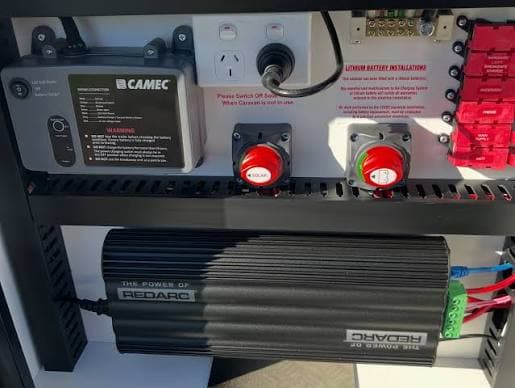
"Can I do my own caravan wiring?" is the wrong question, and it's the reason so much of the advice online contradicts itself.
The right question has two parts, because Australia treats caravan electrical work as two different things depending on a single number — the voltage. Get that distinction clear and almost everything else falls into place: who's allowed to touch it, what paperwork you should be handed, and what you ought to be asking for when you buy a used van.
This article is about the law and the paperwork. It doesn't tell you how to wire anything, and it deliberately doesn't. If you want to work out what size battery and solar setup you actually need, that's a separate question and a separate article.

The line that decides everything
Australian and New Zealand wiring rules draw a line at what's called extra-low voltage, or ELV. Under AS/NZS 3000 — the Wiring Rules — extra-low voltage means an operating voltage not exceeding 50 volts AC, or 120 volts ripple-free DC.
That single definition does a lot of work:
Your 12V system — house batteries, solar, LED lights, the water pump, the fridge on DC, USB outlets — sits comfortably inside ELV.
A 24V system is also ELV.
240V — the power point you plug into at a caravan park, the circuit that runs your air conditioner and your microwave — is not. It's above ELV, and a completely different set of rules applies.
Almost every argument you'll read in a forum thread is two people talking about different sides of that line without realising it.
One clarification worth making early, because the words are used loosely: in everyday trade conversation people call 12V "low voltage". Technically, under the Wiring Rules, 240V is low voltage and 12V is extra-low voltage. It sounds pedantic until you're reading a regulation, at which point it's the whole meaning.
240V: a licensed electrician, everywhere, no exceptions
Work above extra-low voltage is licensed electrical work in every Australian state and territory. If it involves your van's 240V system — the inlet, the circuit protection, the power points, the hard-wired appliances — it must be done by a licensed electrician.
This isn't a formality, and it isn't us being cautious for the sake of it. A caravan is a metal box, often damp, frequently a long way from help, plugged into an unfamiliar supply at a site you've never used before. Bad 240V work in that environment is unforgiving. It also tends to surface years later, in someone else's hands, after the van has been sold on.
What matters for you as an owner is the second half: licensed work generates a document, and you're entitled to it.
The paperwork — and what it's called where you are
Here's where it gets genuinely confusing, because the certificate exists everywhere but the name and the process differ by state. Two worked examples show the shape of it.
In Victoria, licensed electrical work produces a Certificate of Electrical Safety (COES). Energy Safe Victoria splits work into prescribed and non-prescribed. Prescribed work — the heavier categories, including battery energy storage systems — must additionally be inspected by an independent Licensed Electrical Inspector, and a prescribed certificate is required for it. Non-prescribed work covers everything else and doesn't require that independent inspection. Copies of a prescribed COES must reach the customer, the relevant distribution business and Energy Safe within 16 calendar days; non-prescribed copies must reach the customer and Energy Safe within one month. The electrician keeps their copy for three years. Failing to comply is an offence.
In New South Wales, the equivalent is a Certificate of Compliance for Electrical Work (CCEW), required whenever electrical work has been carried out, under the Gas and Electricity (Consumer Safety) Act 2017 and its 2018 Regulation. It must be submitted no later than seven days after the electrical test is completed. Substantial penalties apply — including on-the-spot fines of up to $1,000 for each occasion a CCEW isn't supplied to Building Commission NSW.
⚠️ One recent change worth knowing if you're in NSW: since 1 July 2026, all CCEWs must be submitted through the BCNSW eCert portal. Handwritten and PDF forms are no longer accepted. If an electrician offers you a handwritten certificate for work in NSW, something is out of date.
Every other state and territory runs its own version of this scheme, with its own name, its own timeframes and its own regulator. We haven't verified all eight, so we're not going to list names we haven't checked. Ask your electrician which certificate applies to your job, and ask for your copy. A licensed electrician will not be remotely surprised by the question.
12V: outside the licensing framework isn't the same as unregulated
This is where most of the confusion lives, and where we need to be careful — because the honest answer is it depends on where you are, and we're not going to pretend otherwise.
Queensland gives the clearest published definition. There, electrical work means work at voltages above extra-low voltage, plus work on cathodic protection systems, plus work at extra-low voltage in hazardous locations. On that definition, ordinary 12V work in a caravan generally sits outside the electrical licensing framework — but note the third limb: ELV in a hazardous location is licensed work. A caravan carrying LPG has areas where that distinction stops being theoretical.
Queensland has also been actively clarifying this. The Electrical Safety and Other Legislation Amendment Act 2024 amended the definition of electrical work in the Electrical Safety Act 2002 to confirm that certain tasks involving prescribed electrical equipment — connecting and disconnecting it with other extra-low voltage equipment, where the voltage doesn't exceed ELV and the task can be safely done by someone without electrical expertise — are not electrical work, and so don't require a licensed electrical worker.
That's Queensland. Other jurisdictions define electrical work in their own terms, and we did not verify them state by state. So the only responsible thing we can tell you is this: what you personally may and may not do to your own van at 12V is a question for your state or territory's electrical safety regulator, and it is much better asked before you buy the parts than after you've installed them.
What is not in doubt is the second half of the heading. Falling outside a licensing scheme is not the same as being unregulated, and it is certainly not the same as being safe. A modern lithium bank can deliver an enormous amount of current into a mistake very quickly — enough to start a fire in a confined space made largely of soft furnishings. The standards still apply to the installation whether or not a licence is required to perform it.
The two standards that actually apply to your van
There are two you'll hear referenced, and it's worth knowing which is which:
AS/NZS 3001.1:2022 covers the electrical installation in transportable structures and vehicles, together with the site supplies that feed them — which is why it's the standard behind both your van's 240V installation and the powered site you plug into at a caravan park. It includes testing and inspection requirements.
AS/NZS 3001.2:2022 covers the extra-low voltage side — the battery and associated systems in caravans, motorhomes and camper trailers. It applies to systems installed or significantly modified after 18 November 2023.
That date matters more than anything else on this page if you're retrofitting. A great deal of the build advice online was written before it and hasn't been revisited.
⚠️ A trap worth knowing about. These are joint Australian and New Zealand standards, so material written to them frequently blends the two countries' compliance systems — and the compliance systems are not the same. New Zealand, for example, runs a periodic Warrant of Electrical Fitness scheme for caravans. That is a New Zealand requirement. We could not verify a national Australian equivalent, and we're not claiming one exists either way. When you're reading about caravan electrical certificates online, check which country the page is describing before you act on it.
Who signs it off, and what you should end up holding
For any 240V work on your van, you should finish with:
The certificate — the COES, CCEW or your state's equivalent, in your name, for this job.
The electrician's licence details. Most state regulators publish a searchable register; Victoria's is public. Looking someone up takes a minute.
Documentation for the system itself — battery specifications, inverter and charger details, and what was actually installed where.
For a substantial 12V or battery system, even where no certificate is legally required, ask the installer for a written description of what they fitted and to what standard. It costs them nothing and it is worth a surprising amount later.
Why this matters when you buy — and when you sell
If you're buying a used van, especially one with a retrofitted solar or lithium setup, ask for the paperwork. A seller who produces a folder — certificates for the 240V work, installer details, battery specs — is telling you something good about how the van has been looked after.
A seller without one isn't necessarily hiding anything. Plenty of honest owners have simply lost the documents, or bought the van that way themselves. But you are then buying an unknown, and it should be priced like one, and it is worth having a qualified auto electrician look over any significant system before money changes hands.
If you're selling, the reverse is your opportunity. Very few private listings include this material. Putting your certificates and installation details together takes an afternoon and quietly answers the question every cautious buyer is already asking.
Find someone licensed near you. VANTURE's services directory lists 2,387 caravan and motorhome specialists across Australia — including auto electricians and solar installers. Find a service provider · How the services directory works
The short version
The dividing line is 50V AC / 120V ripple-free DC. Below it is extra-low voltage; above it isn't.
240V work requires a licensed electrician, everywhere in Australia. No exceptions, no "unless you're handy."
That work produces a certificate — a COES in Victoria, a CCEW in NSW, an equivalent elsewhere. Ask for your copy.
12V sits outside licensing in general terms, but the detail varies by state, and ELV in a hazardous location can still be licensed work. Ask your regulator, not a forum.
AS/NZS 3001.2:2022 applies to battery systems installed or significantly modified after 18 November 2023. Older online advice predates it.
Paperwork is worth real money when you sell, and worth real protection when you buy.
We're not going to give you wiring instructions, for 240V or for 12V. What we can do is make sure you know which questions to ask, which document to expect, and who to ask when the answer depends on your state. That's usually the part that's missing.
Also in this series
Thinking of selling? Sell your caravan on VANTURE — free to list, same price whatever it's worth, and no commission ever.
List your caravan free