What to Look For on an Off-Road Caravan: Chassis, Suspension and What the Labels Actually Mean

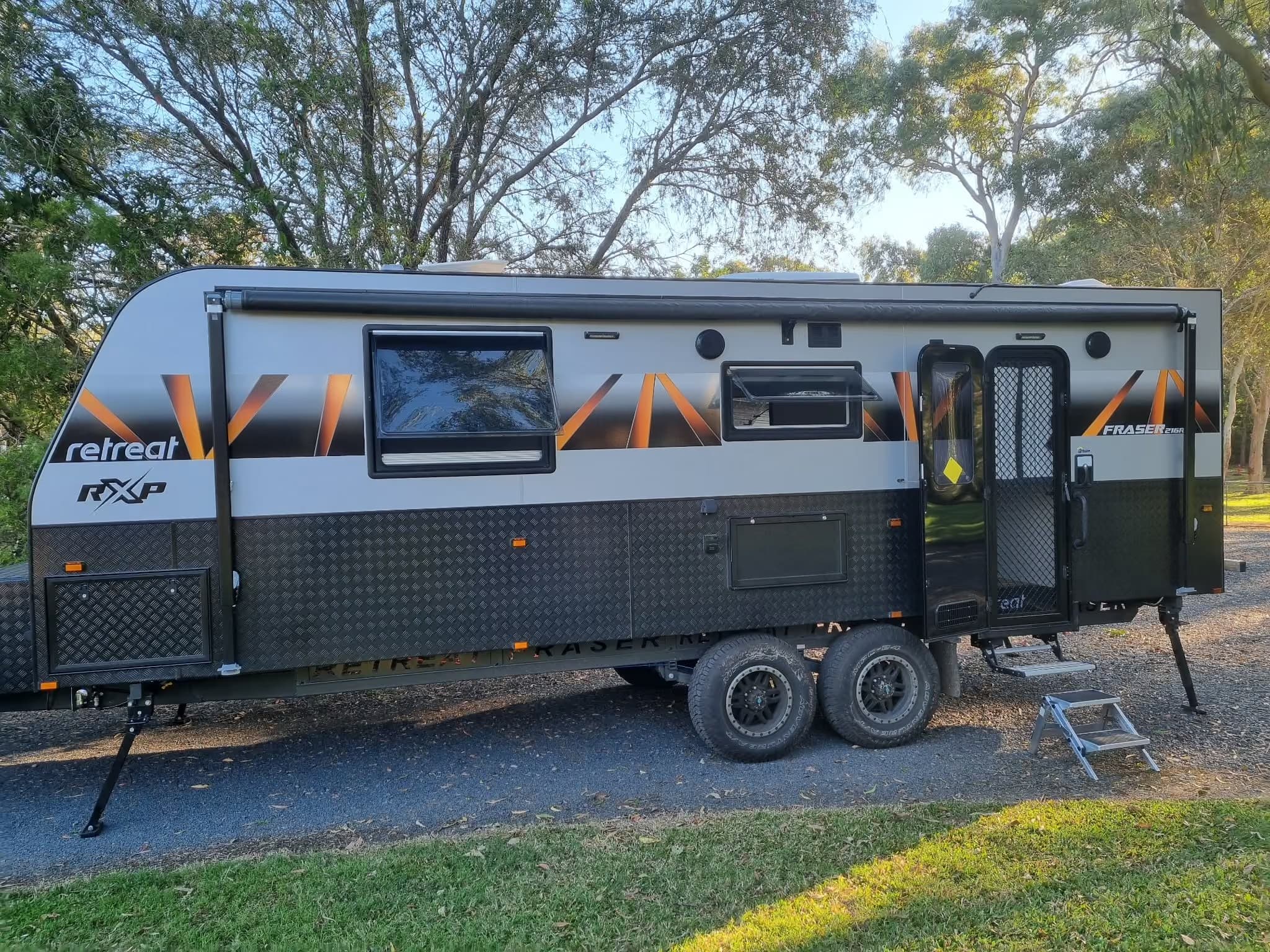
Few purchases say "we're doing the big trip properly" like an off-road caravan. Australians are heading further off the bitumen every year, and the industry has answered with some genuinely impressive engineering — vans built to follow a four-wheel drive most of the way to anywhere.
Here's the thing to understand before you start shopping, though: "off-road" is not a standard. There's no Australian certification, no independent test, no rulebook that says what a caravan must have before the badge goes on. "Semi off-road", "off-road", "extreme off-road" — each manufacturer uses these terms their own way, usually in good faith, to describe what they built the van to do. That's not a scandal. It just means the label can't do your homework for you.
The hardware can. A van's chassis, suspension, clearance, coupling and sealing tell you exactly what it's built for — and they can't be vague. This guide is about learning to read them.

One honest question first: if you're still deciding whether you need an off-road van at all, start with our guide to which caravan format actually suits your trip. Plenty of wonderful Australian touring — including most of the big-lap classics — happens on bitumen and well-maintained gravel. Off-road capability you'll never use costs money and weight. Off-road capability you need and don't have costs a lot more. The goal is a match.
What the labels generally mean
While the terms aren't standardised, the industry does use them along a recognisable spectrum. Treat these as a starting translation, then verify against the hardware:
Touring / on-road — built for sealed roads and short stretches of good, formed gravel: the caravan park run, the coastal lap.
Semi off-road — typically some combination of a strengthened chassis, upgraded suspension, more clearance and better underbody protection. Built to handle corrugated gravel and formed dirt roads at sensible speeds — the national park access road, the station track to the campsite.
Full off-road — engineered to follow your four-wheel drive on rough, rutted tracks: high clearance, long-travel suspension, an articulating coupling, serious protection underneath, and sealing against dust and water.
The label is the manufacturer's summary of intent. The next five sections are how you check the summary.
1. The chassis
The chassis is the van's skeleton, and on an off-road van it's doing much harder work.
What to look at: the size and construction of the main rails and the A-frame (off-road vans typically run heavier sections and more substantial drawbar bracing), the quality and consistency of the welds, and the corrosion protection. Hot-dip galvanising — where the finished chassis is dipped in molten zinc — is the benchmark protection for a van that will see water crossings and stone spray; painted and coated chassis can be perfectly good but rely on the coating staying intact.
On a used van, the chassis is the biography. Get underneath with a torch. Look along the main rails and around the suspension mounting points for hairline cracks, fresh paint over old repairs, or doubled-up plating. Check the A-frame for repair welds. Surface rust is normal life; cracked or repaired structure is a conversation you need to have with the seller — and a good case for a professional pre-purchase inspection.
2. The suspension
This is the biggest hardware difference between the categories, and the place where "better" depends entirely on your trips.
Beam axle with leaf springs is the traditional setup: simple, proven, cheap to maintain, and repairable in any town in Australia. For sealed roads and moderate gravel it remains a completely honest choice, and plenty of semi off-road vans run upgraded leaf setups that handle corrugations well.
Independent suspension — trailing arms with coil springs or airbags, each wheel moving on its own — is what you'll find on most vans built for genuinely rough tracks. Each wheel can follow the ground independently, which keeps the van composed on corrugations and ruts and reduces the shock loads fed into the chassis and cabinetry. The trade-offs are more moving parts, more cost, and more that needs servicing.
Either way, look at the details: quality shock absorbers (corrugations are a shock-absorber endurance test — many off-road setups run two per wheel), the condition of bushes and mounts, and on a used van, any evidence of bottoming-out or impact damage around the suspension travel limits.
3. Clearance and geometry
Clearance is what stops the track touching the van. Three things to look at, all with your own eyes:
Ride height — the gap under the lowest points: axles, water tanks, plumbing, spare wheel. On a genuine off-road van, tanks and pipes should be tucked up and shielded, not hanging in the breeze.
Departure angle — crouch at the back of the van and sight the line from the rear wheels to the lowest rear point. A long overhang with a low bumper is what scrapes on creek exits and washouts; off-road designs cut the rear away for exactly this reason.
Underbody protection — stone shielding on the leading edges, protected brake lines and wiring, shielded plumbing. Gravel travel is a constant low-grade stone blast; the van should be dressed for it.
4. The coupling
A standard 50 mm ball coupling is fine for sealed roads, but it has limited articulation — on badly uneven ground, a track can ask for more angle between car and van than the ball can give.
Off-road couplings are built to articulate through the full range a rough track demands. If the van you're looking at wears an off-road badge but a standard ball coupling, that's not a fault — it's information about what the manufacturer really expected the van to do. On a used van, check the coupling for play and wear, and confirm it suits (or can be matched to) your tow vehicle's setup.
5. Dust, water and the details
Genuine off-road capability shows up in small things: door and hatch seals in good condition, a dust-reduction or pressurisation system for travel on powder-dry roads, and light-truck-construction tyres with at least one matching spare — two for remote work.
On a used van, dust is the tell-tale. Open every cupboard and drawer and look in the back corners. Fine red dust through the interior means the van has done real outback miles with imperfect sealing — which is worth knowing both for what it says about wear, and for what it says about the sealing.
While you're inside, the standard used-van inspection applies in full — floor, water staining, bearings, gas, electrical, PPSR. Our 27-point buyer's checklist walks through every item.
The weight conversation
All of this capability — heavier chassis, independent suspension, bigger tanks, protection plating — weighs something, and off-road vans are consistently heavier than their touring equivalents at the same size. That has two consequences worth checking before you fall in love:
Your car has to tow it. Check the van's ATM against your vehicle's real, loaded towing capacity — our complete GVM, GCM and ATM guide shows how to work that out properly, and why the brochure figure isn't the whole story.
You still need payload. A van that's heavy empty has less capacity left for water, gear and the second spare — the very things remote travel demands. The compliance plate (tare vs ATM) tells you the honest number.
Questions worth asking any seller
However the van is badged, these questions get to substance — and every one of them has a fair, factual answer a good seller or dealer will be happy to give:
"What suspension is fitted, and what's it rated for?"
"Is the chassis hot-dip galvanised, or coated?"
"What conditions was the van designed for — and does the warranty describe where it can be taken?" Manufacturers design for an intended use, and warranties often describe it. Reading those conditions before you buy simply makes sure your plans and the van's design agree.
For a used van: "Where has it actually travelled, and what's been repaired or upgraded along the way?" A van that's done the Gibb with a service history to match can be a better buy than one that's never left the bitumen — the point is knowing.
The short version
Don't buy the label — buy the hardware, matched to the trips you'll really do. Chassis, suspension, clearance, coupling, sealing, weight: six things, all checkable in an afternoon, all fair questions to ask. The Australian industry builds some of the most capable towable vans in the world, across every point on this spectrum — your job is just to find the point that matches your map.
Start looking: browse off-road caravans for sale on VANTURE — including used off-road caravans — with the specs that matter shown on every listing.
Also in this series
Thinking of selling? Sell your caravan on VANTURE — free to list, same price whatever it's worth, and no commission ever.
List your caravan free