Should You Pay for a Pre-Purchase Caravan Inspection? What They Check and What It Costs

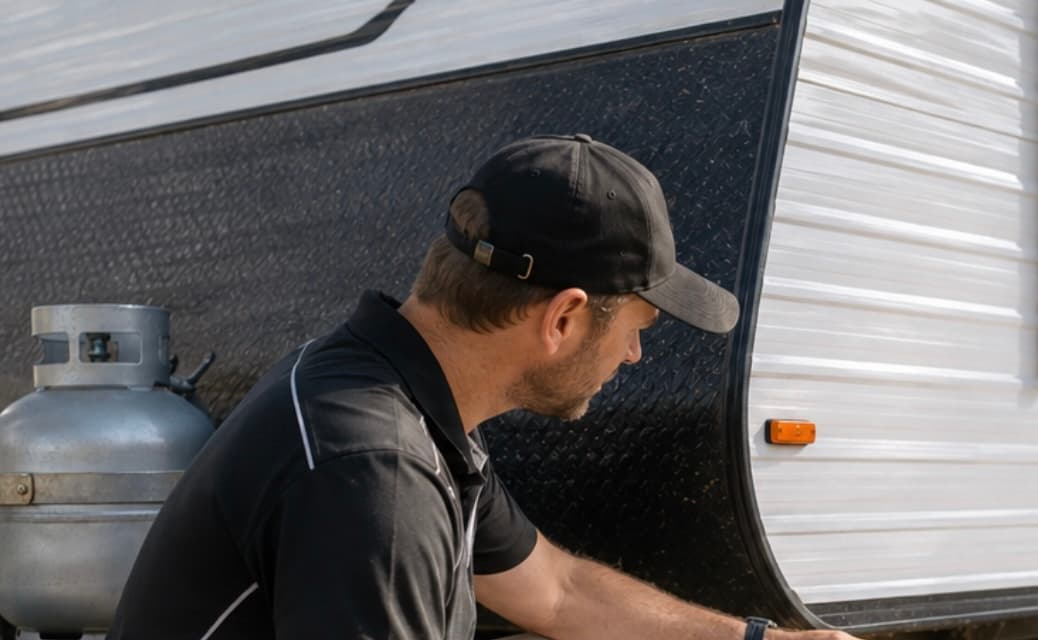
There's a moment in every used caravan purchase where you've done your own walk-through, you like the van, the seller seems straight, and you're standing there wondering whether to spend a few hundred dollars having someone else look at it too.
It's a fair question, and the honest answer isn't always yes. A pre-purchase inspection is a genuinely useful piece of professional work, but it isn't magic and it isn't free, and there are purchases where it earns its keep several times over and others where your own careful hour is enough.
Here's what one actually involves in Australia, who does them, what it costs, and how to decide.

First: what a pre-purchase inspection is not
A lot of confusion here comes from four different services wearing similar names. They aren't interchangeable.
A pre-purchase inspection is a voluntary, private report you commission for your own benefit. It tells you the condition of the van you're thinking of buying. Nobody requires it, no government body sees it, and it has no legal standing — its value is entirely in what it tells you before you commit.
A roadworthy or safety certificate is a state-regulated check, tied to registration or transfer, done to a set standard. It answers "is this legal to be on the road", which is a much narrower question than "is this a good van".
A weighbridge check or mobile weigh measures what the van actually weighs — real tare, real ball weight, axle loads. That's a different service with different equipment, though several businesses offer both.
Gas and electrical compliance certificates are separate again, issued by licensed people, and they're about specific installed systems.
You can want all four. Just don't assume one gives you another. When people say "the van had a roadworthy so it must be fine", they're leaning on a document that was never designed to carry that weight.
Who actually does caravan inspections in Australia
This is where caravans differ from cars. There's no single profession that owns "caravan inspector" — and it shows in the market.
VANTURE's own services directory currently lists 182 verified pre-purchase inspection and weighing providers across the country: 53 in Victoria, 28 in New South Wales, 28 in Western Australia, 24 in South Australia, 16 in Tasmania, 13 in Queensland, 11 in the Northern Territory and 9 in the ACT. Read down that list and you'll see three quite different kinds of business:
Dedicated vehicle inspection companies. These do pre-purchase inspections as their core product, usually mobile, usually with tiered packages and a standardised digital report. They're systematic, and their reports tend to be the easiest to read and to hand to a seller during a negotiation.
Caravan repairers and technicians. These are the people who fix vans all week. They know exactly where a particular build tends to let water in, because they've cut the wall open. Their reports may be less polished, but their eye for the things that cost real money is hard to beat.
Weighing specialists. Mobile weighing businesses have grown quickly in Australia, and many now bundle a condition check with the weigh. If weight is your main worry — and for a lot of buyers it should be — this pairing is efficient.
None of these is automatically the right choice. What matters is matching the provider to the risk you're most worried about. If the van has spent its life on dirt, a caravan technician's opinion on the chassis and suspension is worth more than a tidy PDF. If you're buying near your towing limit, get it weighed.
You can browse pre-purchase inspection and weighing providers on VANTURE by state and by distance from you, with owner reviews attached.
What an inspector actually checks
A caravan inspection is not a car inspection with a bigger clipboard. There's no engine on most vans, no test drive in the usual sense, and the failure modes are completely different — water, weight, structure, and the systems that make a van liveable.
A reasonable caravan inspection covers:
Structure and body. Roof, walls, floor and their joins. Signs of delamination, panel movement, previous repairs, and stress around windows and hatches.
Water — the big one. Moisture readings and visual inspection of the classic entry points: roof seams, window and door seals, hatch flashings, wall-to-floor junctions, and inside lockers. Water damage is the single most expensive thing a used caravan hides, and it's the reason most people book an inspection at all.
Chassis and running gear. Drawbar and A-frame, main rails, suspension mounts, springs or independent arms, wheel bearings, brakes and tyres including the date codes.
Coupling and towing hardware. Condition and operation of the coupling, the handbrake, the jockey wheel and the breakaway system.
Electrical, 12V and 240V. Lights, pump, appliances, power points, battery and solar behaviour where it can be tested.
Gas appliances. That everything lights and runs, and the state of the plumbing and compliance plate.
Interior and fit-out. Cabinetry, bed lifts, drawers, seals, the shower and the toilet.
Documentation. Compliance plate details checked against what's been advertised — and that check alone is worth booking for.
One detail worth knowing, because it changes what you get: the deeper inspection packages test things in operation, not just visually. South Australian provider All In Vehicle Inspections says on its own booking page that for its premium caravan inspection it advises the van be connected to power and water for best results. That's a small, practical thing to arrange with the seller in advance — and it's the difference between "the hot water system is present" and "the hot water system works".
What it costs
Prices are set by each business and vary with location, van size and how much you want included, so treat any figure as a starting point and get a quote from the provider you choose.
As a live, published example: All In Vehicle Inspections lists its caravan pre-purchase inspection at $270 to $390 (checked 6 August 2026), spanning an Essential level — safe, roadworthy and a visual condition check including a visual moisture check of the walls — and a Premium level, which adds operation of components inside and out, a fuller diagnostic and structural inspection, and a detailed photo report.
The same published price list shows the things that move the number, and they're worth knowing whoever you book with:
Travel. The first 25 km is included; beyond that, published zone surcharges run $200, $300 and $400. If the van is out of town, distance is often the biggest single line on your invoice.
Extra axles. $30 for each axle beyond the first, so tandem-axle vans cost a little more.
Add-ons. A video walkthrough of the van running, and a drone check of the roof, are listed at $65 each. The roof is the part of a caravan you can't see and the part most likely to be hiding something.
Age. Extra charges apply to older vans, with classics priced separately.
Two things follow from that. First, the headline price isn't the price — check travel and axles before you compare providers. Second, the drone roof option exists precisely because roofs matter and are hard to see; on a taller van, or one you can't get above, it's a sensible add.
When it's clearly worth it
Buying interstate or sight-unseen. If you can't stand in front of the van, an inspection is not optional — it's your eyes. This is the single strongest case.
Older vans, or any van that's lived near salt water. Age and coastal life are the two great accelerants for the things that cost the most.
When the price is high enough that a few hundred dollars is a rounding error. On a $60,000 van, the arithmetic answers itself.
When you found something you couldn't judge. A soft spot in a floor, a stain in a locker, a fine line in the chassis paint. Don't adjudicate that in someone's driveway. Hand it to a professional.
When you're not confident, full stop. First caravan, no mechanical background, no one to bring along — that's exactly what the service is for, and there's nothing to feel awkward about.
When you might reasonably skip it
On a genuinely cheap van where the inspection is a big share of the price. At the bottom of the market you're buying with your eyes open and accepting risk knowingly. Just be honest that that's the deal.
On a new van from a dealer. A new caravan comes with the manufacturer's warranty and your consumer guarantees under Australian Consumer Law, and the dealer does a pre-delivery inspection. Your energy is better spent on the handover than on a third-party report.
When you're already paying a specialist for the specific worry. If your one concern is weight and you've booked a mobile weigh, you may not need a general condition report as well.
When you've genuinely got the skills. Plenty of buyers have spent a working life around trailers, workshops or building sites. If that's you, an inspection is a second opinion rather than a necessity.
Getting the most out of the one you book
Do your own walk-through first. An inspection is a much better use of money once you've decided you actually want the van. Our 27-point first-time buyer's checklist is a good structure for that first pass.
Tell the seller before you book. Most inspection businesses will ask whether the seller knows and is expecting a call — All In's booking form asks exactly that. A seller who's happy to accommodate an inspection has told you something useful. So has one who won't.
Send the listing link. Providers routinely ask for it so they can prepare. Give them the make, model, year and anything specific you want looked at.
Arrange power and water access if you're paying for the deeper package. It's the cheapest upgrade you'll make.
Then actually use the report. A written condition report is the most civil negotiating tool in the used caravan market. It moves the conversation from opinion to a list, and most sellers respond well to a list. The outcomes are simple: buy at the price, buy at a lower price with the work quoted, or walk away having spent a few hundred dollars instead of tens of thousands. All three are good outcomes.
What an inspection still doesn't cover
Three things sit outside almost every pre-purchase inspection, and all three are on you:
A PPSR search. An inspector reports on condition, not on whether there's finance owing, or whether the van has been written off or reported stolen. That's a separate, cheap, essential check — see our guide to PPSR checks for caravans.
Certificates. Gas and electrical compliance are issued by licensed people; you can find gas and LPG services separately.
The tow match. Whether your car can tow this van is a question about two vehicles and a set of numbers, and no inspector answers it for you. Our GVM, GCM and ATM guide and the free tow compatibility tool do.
If the inspection turns up work rather than a walk-away, caravan repairers on VANTURE can quote it before you commit — which puts a real number in your offer instead of a guess.
An inspection is not the price of admission to buying a used caravan. Plenty of good purchases happen without one. But it's a small, bounded cost against a large, unbounded one, and for most buyers most of the time, that trade is a comfortable one.
Ready to look? Browse used caravans for sale on VANTURE — and when you find one worth committing to, find a pre-purchase inspection provider near you before any money changes hands.
Thinking of selling? Sell your caravan on VANTURE — free to list, same price whatever it's worth, and no commission ever.
List your caravan free