Caravan or Camper Trailer? Which One Actually Suits How You Travel

The question underneath the question
Ask around a campground and you'll get strong opinions in both directions, delivered warmly and with total conviction. The camper trailer people will tell you they can get places you simply can't. The caravan people will tell you they were in bed twenty minutes after arriving. Both are right. Neither is answering your question.
Because "caravan or camper trailer" isn't really a question about the trailers. It's a question about how you travel — how often you move, what you tow with, what the weather does to your mood, and how much of your holiday you're willing to spend setting up and packing down.
Get that part right and the trailer choice mostly makes itself. Get it wrong and you'll own something excellent that doesn't suit you, which is a slow and expensive kind of disappointment.

This guide walks through the decision the way we'd walk through it with you at a show. No winner is declared, because there isn't one.
First, what they actually are
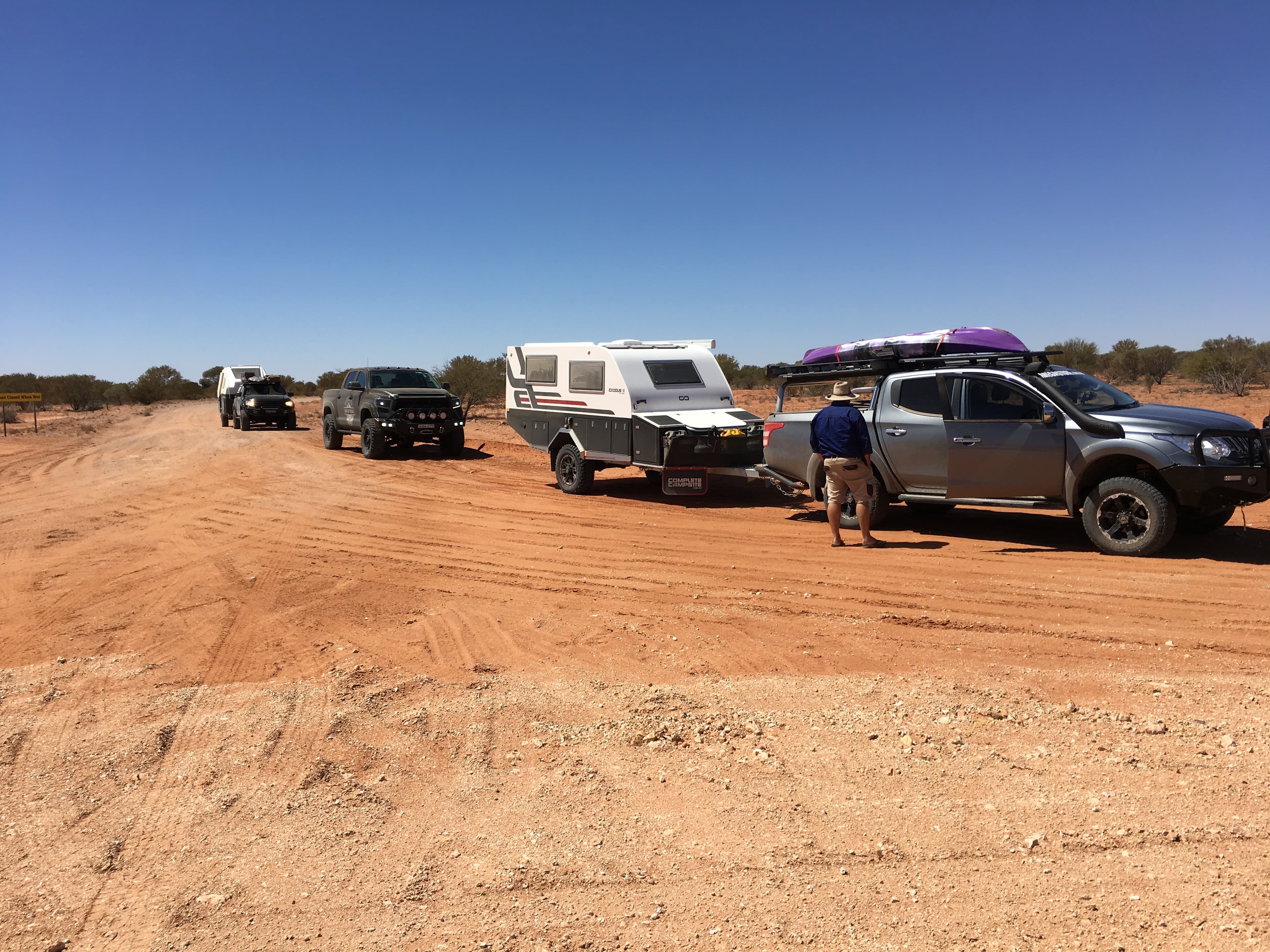
A camper trailer is a trailer that opens out into a camp. Depending on the design, the bed folds out over the drawbar or the body, canvas goes up over the top, and a kitchen usually slides or swings out the back. You sleep in a bed, but the walls around you are canvas. They're generally low, generally light, and generally built to be dragged somewhere interesting.
A caravan is a hard-sided trailer you sleep inside. The bed is made. The roof is solid. Most touring vans have a kitchen, a fridge, seating, and — for a great many Australian buyers, the deciding feature — a bathroom.
Both are trailers. That matters more than people expect, because it means both live under the same national rulebook, both need registration, and both need a tow vehicle that's genuinely up to the job.
The rules treat them as the same thing — which is useful to know
Trailers up to 4.5 tonnes aggregate trailer mass are covered by Vehicle Standards Bulletin 1, the national standard for how light trailers must be built. A camper trailer and a family caravan sit under the same document. There is no separate, softer standard for camper trailers.
Where the two formats genuinely diverge is which side of the braking thresholds they land on — and those thresholds are worth knowing before you shop, because they quietly determine what your car has to be able to do.
VSB 1 sets its braking requirements in Gross Trailer Mass, not Aggregate Trailer Mass — the bulletin says so directly and highlights the point itself. GTM is the weight carried by the trailer's own wheels; ATM includes the load pressing down on your tow ball. GTM is always the smaller of the two, and both are on the compliance plate.
The ladder, from VSB 1:
Up to 750kg GTM, single axle — no brakes required.
Over 750kg GTM, or more than one axle — an efficient service braking system is required, activated by a control signal from the tow vehicle (over-run brakes excepted).
Up to 2,000kg GTM — brakes may be fitted to one axle only, and over-run brakes are permitted.
Over 2,000kg GTM — brakes must operate on all wheels, and the trailer needs an emergency breakaway system that applies the brakes if it separates from the car and holds them on for at least fifteen minutes.
Why this belongs in a "which one" article: the two formats frequently land on different rungs of that ladder, and each rung upward asks more of your car, your towing equipment and your confidence. A trailer under 2,000kg GTM is a meaningfully different towing proposition to one above it — not just heavier, but a different class of setup.
Don't estimate this. Read the plate on the specific trailer you're considering. And if a decision hangs on a threshold, check the current standard, because VSB 1's braking chapter carries a note saying its content is under review.
Work out what your car can tow before you fall in love with a trailer. VANTURE's tow-match filter shows only what your vehicle can legally and safely handle. Browse with tow-match on →
The decision that costs the most: what you already own
Here's the part that reorders a lot of shopping lists.
If you already own a mid-size wagon, ute or four-wheel drive that you like and intend to keep, a camper trailer will very likely work with it. That's a large part of the format's appeal — the trailer suits the car you've got.
A full touring caravan is a different conversation. Plenty of Australian families have bought the van first and then discovered the honest answer is a new tow vehicle. That's not a small adjustment. It can rival the price gap between the two trailer types, and it happens after you've committed.
So run the numbers in this order:
What is your tow vehicle actually rated for — braked towing capacity, tow ball download, GVM and GCM?
What does the trailer weigh at ATM, and what's left for your gear?
Does the combination still work when the van is loaded for a real trip, not empty on the lot?
If you're not certain how those numbers interact, our complete GVM, GCM and ATM guide walks through a full worked example, and Understanding ATM, GTM and Tare Weight explains the terms on the plate.
The tow vehicle question is the single most common reason someone ends up with the format they didn't expect — and there's no shame in it. A camper trailer behind a car you already trust beats a caravan behind a car that's working too hard.
How often do you move?
This is the honest dividing line, and it's the one seasoned travellers raise first.
A camper trailer asks something of you at both ends of every leg. Canvas up, poles in, bed out, awning sorted. Then the reverse when you leave — and canvas that went away damp needs airing before it's stored, which is its own small discipline.
People who love their camper trailers are, almost without exception, people who stay put for a while. Four nights, a week, a fortnight in one spot. Amortised over a week, setup is a pleasant half-hour ritual. Amortised over a one-night stop, it's a chore you'll come to resent.
A caravan flips that. Chock the wheels, wind the legs, plug in, kettle on. If your travelling style is a chain of overnight stops on a long run north, the caravan's advantage compounds every single day.
Ask yourself plainly: on a typical trip, how many nights do you spend in each place? If the answer is mostly one or two, weight the caravan. If it's mostly four or more, the camper trailer's case gets a lot stronger.
Weather, and what it does to the trip
Canvas is wonderful. You hear the rain, you feel the morning, you're closer to where you are. There's a reason people are devoted to it.
Canvas is also a different experience on day five of persistent rain, and it's fair to think about that honestly before you buy rather than after. Solid walls change how a wet week feels. So does being able to close a door on wind, dust and mosquitoes, and so does a bathroom you don't have to walk to in the dark.
None of this makes canvas the wrong answer. Plenty of very experienced travellers choose it knowing exactly what they're choosing, and they plan around weather rather than ignoring it. But if you're travelling in shoulder seasons, heading somewhere reliably wet, or simply know that a run of bad weather sours a holiday for you, that's real information about which format suits you.
Where you're actually going
The camper trailer's strongest argument is access.
Lower, lighter and shorter means tracks that a long touring van has no business attempting — tighter turns, steeper pinches, narrower bush campsites, and the sort of ground where departure angle matters. If your travelling imagination involves places reached by dirt with a gate at the start, the camper trailer is a serious answer.
But be honest about the trips you'll actually take, not the ones you enjoy picturing. A great many people buy for the once-a-year adventure and then spend the other fifty weeks doing coastal runs and caravan parks — where the caravan's comforts are the thing you use every day and the camper trailer's access is the thing you rarely need.
The reverse is equally true. If you genuinely go remote, a caravan that keeps you on the blacktop isn't the freedom you paid for.
Storage, when you're home
Not glamorous, and routinely forgotten.
A camper trailer will fit down the side of many Australian houses and inside a fair few garages. A full touring caravan very often won't — which means paid storage, an ongoing cost that never appears in the purchase comparison, plus the friction of retrieving it before every trip. That friction is real: things that are harder to get to get used less.
Measure your gate, your driveway and your garage before you shop. It's a five-minute job that occasionally settles the whole question.
Living space versus getting there
If you strip everything else away, this is the trade.
The camper trailer trades interior living for access and towability. Lighter, lower, cheaper to tow, easier to store, goes further off the bitumen. In exchange you set up every time, you live in canvas, and the indoor space is modest.
The caravan trades access and towability for interior living. You arrive and you're home. Bathroom, fridge, bed, somewhere dry to sit out weather. In exchange it's heavier, longer, fussier to store, and it asks considerably more of your tow vehicle.
Everything else in this article is a variation on that single sentence.
A note worth making kindly
If you're buying for the next decade rather than the next summer, it's worth thinking about how each format ages with you.
Camper trailer setup involves bending, lifting, reaching and working at ground level. Most people manage that comfortably for a long time. But it is genuinely more physical than winding down four legs, and the gap widens over the years. Shoulders, knees and backs all get a vote eventually.
This isn't a reason to rule anything out — plenty of people in their seventies set up a camper trailer faster than someone half their age, and enjoy every minute. It's simply worth factoring in if this purchase is meant to last, alongside the more obvious question of whether a bathroom you can reach at 2am matters to you now or might matter later.
Who each one genuinely suits
A camper trailer suits you if:
You stay put for several nights at a time
You want to reach places a long van can't go
You want to keep the tow vehicle you already own
Storage at home is tight
You like camping, not just travelling — the canvas is part of the appeal
Your budget is better spent on where you go than what you sleep in
A caravan suits you if:
You move often, sometimes overnight
Weather shouldn't be able to spoil a trip
A bathroom matters, or you suspect it will
You want to arrive and be finished
You're travelling for extended stretches and want the van to be genuinely liveable
You have — or are willing to buy — a tow vehicle properly rated for it
If you read both lists and each one had things you wanted, that's normal. Weight them by how you'll spend the most nights, not the most memorable ones.
Before you commit
Whichever way you're leaning, do these five things:
Read the compliance plate — ATM, GTM and tare — and check them against your tow vehicle's ratings. Not the brochure. The plate.
Set it up yourself, in the yard, before you buy. Ask the seller to let you do it unaided and time it. Once is worth more than any review.
Measure your storage at home first.
Count the nights on your last three trips. Your own history predicts your next trip better than your ambitions do.
Inspect it properly. Our 27-point first-time buyer's checklist applies to both formats — canvas, seals, floor, brakes, bearings and chassis all deserve a look.
And if you're weighing the running costs rather than the purchase price, what a caravan road trip really costs breaks down the ongoing side of ownership.
Have a look at both
The most useful thing you can do is stop comparing categories in the abstract and start looking at real trailers, with real plates and real prices.
Browse both, side by side. Camper trailers on VANTURE → · Caravans on VANTURE →
Sit in a few. Set one up. Hitch one to your car if a seller will let you. The answer usually arrives in about ten minutes of standing next to the actual thing — long after the spec sheets have stopped helping.
And when you've decided, VANTURE lists both — with finance available through our partner, and a tow-match filter that only shows you what your vehicle can actually pull.
Also in this series
Thinking of selling? Sell your caravan on VANTURE — free to list, same price whatever it's worth, and no commission ever.
List your caravan free