Pop-Top, Full-Height, Expander or Hybrid? A Plain-English Decision Tree for Australian Caravan Buyers

Before you fall for a layout, a colour scheme or a clever kitchen, there's a decision that sits underneath all of them: what shape of van are you buying?
Australian caravans come in four body formats — full-height, pop-top, expander and hybrid — and each one makes a different bargain between living space on site, towing size on the road, and how much work you're prepared to do at both ends of the day. Get the format right and the rest of the shopping list gets easier. Get it wrong and no amount of interior styling will fix the fact that the van doesn't fit your carport, your car or your patience.
We've written before about choosing between off-road, hybrid and pop-top vans for the kind of trip you take. This guide is the step before that one: the four body formats, side by side, with particular attention to the expander — the family workhorse that almost nobody explains properly — and a six-question decision tree you can run in your head at the next show.

The four formats in one paragraph each
Full-height (or "full van"). A hard-walled caravan at its full standing height all the time. Park it, wind the legs down, walk in. Maximum internal storage, the best insulation and weather-sealing of the four, and the least setup. The trade-offs are size and drag on the road, and the tallest profile to store at home.
Pop-top. A hard-walled caravan whose roof section lowers for travel and lifts at camp, with a canvas or vinyl skirt filling the gap. Lower and slipperier on the road, easier to fit under a carport, and usually lighter than the same layout in a full-height body. You lose the top of the walls — overhead cupboards are shallower or absent — and the skirt is a weak point for weather and wear.
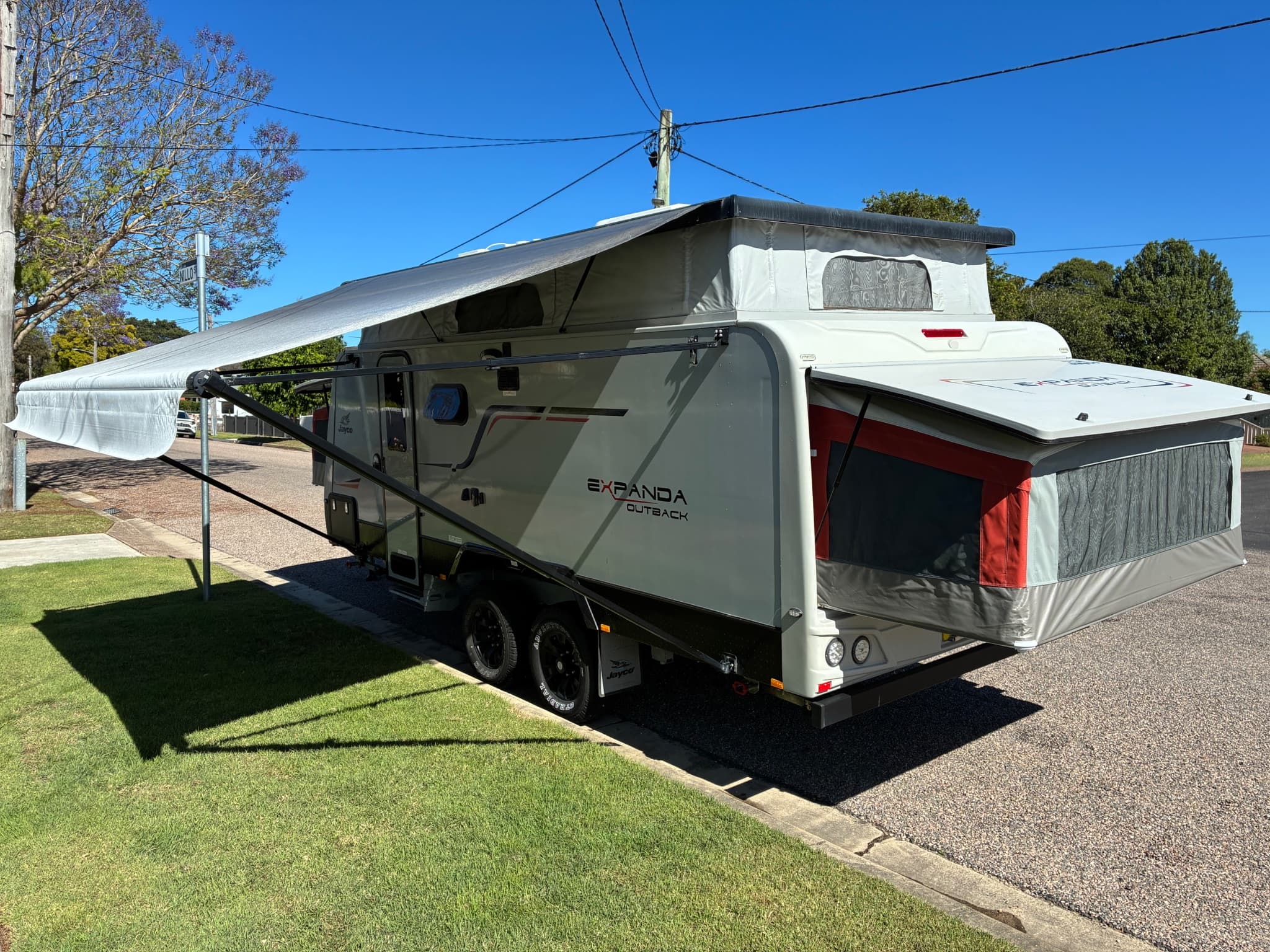
Expander. A hard-walled body — often a pop-top — with one or two bed ends that fold out of the van on canvas, like a camper trailer's bed pods bolted to a caravan. The bed ends add sleeping space without adding body length, which is why the expander became Australia's default family van for two decades. In exchange, you're setting up canvas ends every stop and towing a van whose hitched length is a good deal longer than its body.
Hybrid. The blurriest of the four terms. In current Australian usage a hybrid is a compact, hard-walled, usually off-road-capable van that borrows from camper trailers: small footprint, outside kitchen, often a pop-top or lift roof, sometimes a slide-out bed. It's the format for people who want to go where a full van won't, and are willing to live smaller to do it. We've made the case against it, and the case for it, in The Case Against the Hybrid Caravan — and Where It Falls Down.
The expander, properly explained
Most buying guides skip the expander or lump it in with pop-tops. It deserves its own section, because for families it's often the right answer, and for couples it's often the wrong one — and the reasons are specific.
Where it came from
The format is inseparable from one model line: the Jayco Expanda. Caravan World's review of the current Expanda 17.56-2 (April 2025) records that the first one rolled off the Dandenong production line in 2000 and that some 20,000 have been built since. The review's own phrase for the original idea is worth keeping: the Expanda was a hybrid between camper trailer and caravan, "offering the best of both worlds." That is exactly the pitch — the fold-out beds and towability of a camper, with the bathroom, kitchen and storage of a proper caravan.
Twenty years ago, Caravan World noted, it was hard to find a caravan with bunks at all, and the Expanda filled that gap so well it became the most popular family van in the country. Other builders have offered their own versions; on VANTURE's model database there are 22 expander models across 12 brands, though on any given week only a handful are listed for sale — four at the time of writing — because owners tend to keep them until the kids grow out of them.
How the bed ends actually work
At each end of the van there's a hinged panel. On older vans it was a soft canvas lid; on current models it's a hard fibreglass lid that protects the canvas from sun and rain when closed. To set up, you unlock and lift the lid, fold the bed base out until it's horizontal on its supports, then go inside, unfold the mattress to full width and fit a tensioning arm that holds the canvas roof up over the bed. Flyscreens on three sides let air through. Pack-down is the reverse, with the mattress folding at least once so the base can fold back into the van.
That sequence is why expander owners talk about "jobs." Caravan World's reviewer — a long-term Expanda owner — describes a family routine where each person has assigned tasks, one inside, one outside, one winding legs. It's not hard, and people do it in minutes, but it's every stop, in every weather, and it's the single biggest reason expanders suit families better than couples. Two adults doing a one-nighter in the rain feel every one of those steps. Four kids who get their own bed end don't mind at all.
What it gives you
Sleeping capacity without body length. A six-berth expander can have a body length of a compact tourer, because two of the double beds live outside the box. Caravan World's spec table for the 17.56-2 lists a body length of 5.62 m and an ATM of 2,353 kg for a van sleeping six — a combination no full-height six-berth can match.
Towability. Lighter than a comparable full-height six-berth, and with a pop-top roof, lower on the road. Caravan World's summary of the format is that it "doesn't need a massive tug."
Price. New and used, expanders sit below full-height family vans of similar sleeping capacity, and there's a deep secondhand market.
What it costs you
Setup, every time. Covered above. Be honest about how you actually travel.
Canvas. The bed ends are canvas — Caravan World notes the current model uses 14 oz Australian canvas, double stitched — and canvas needs care: dry before packing, check stitching and seams, keep the hard lids sealed. On a used expander, the bed-end canvas and the seals around the hard lids are the first things to inspect; our water damage and delamination guide covers what a leak at the bed end does to the ceiling and cabinetry below it.
Hitched length. This one surprises people. The body may be compact, but the drawbar and folded bed ends push the on-road length well past it. The same Caravan World spec table lists the 17.56-2 at 7.98 m overall against its 5.62 m body — more than two metres of difference. Measure your storage spot against the overall figure.
Off-grid limits. Caravan World is candid that expanders, even outback-spec versions, are built for caravan parks and a night or two of free camping between them, not for extended off-grid living. Battery and water capacity reflect that. If remote touring is the dream, this isn't the format.
Weather and insulation at the ends. Canvas is canvas. Warm nights in the tropics with flyscreens open are lovely; cold, windy nights on the Great Ocean Road are less so.
The six questions
Run these in order. Most people know their format by question four.
1. Where will it live when you're not travelling?
Measure the carport, the side of the house or the storage bay — height and length. A full-height van needs the most headroom; pop-tops and most expanders sit lower for the trip home; hybrids vary. For length, use the overall (hitched) figure, not the body. If the honest answer is "it won't fit anywhere at home," read our guide to caravan storage costs and council rules before you go any further, because storage fees change the maths on every format.
2. What's towing it, and how much can it carry?
Weight decides more than length does. Pop-tops and expanders generally sit lighter than the same floor plan in full height; hybrids can be surprisingly heavy for their size once the off-road hardware is under them. Whatever you're towing with, the check is the same four numbers — the van's ATM, the car's GVM, its GCM and the tow ball download — and our complete GVM, GCM and ATM guide walks through them. If you're towing with a mid-size SUV, start from the under-1,500 kg list.
3. Who sleeps in it?
Two adults: any format. This is the question that lets couples skip the expander — they're paying in setup for sleeping capacity they don't need.
Two adults and one or two children, occasionally: a full-height or pop-top with a dinette bed or a single bunk.
Two adults and two or more children, regularly: this is expander territory, or a bunk-layout full-height van if the budget and tow vehicle allow.
4. How often do you move?
This is the question that separates the formats most sharply.
Frequent one- and two-night stops (touring, chasing weather, heading north in winter) reward the format with the least setup: full-height first, then pop-top. The expander's setup routine is a real cost here, multiplied by every stop.
Long stays (a fortnight at the coast, a season in one park) make setup almost irrelevant. A few minutes once a fortnight costs you nothing, and the lighter, cheaper formats give up little.
5. Where are you going?
Sealed roads and caravan parks suit every format. Formed gravel and station tracks suit full-height and pop-top vans built for it, and hybrids by design. Genuinely remote, extended off-grid touring narrows the field to full-height off-road vans and hybrids — the ones with the tanks, batteries and hardware for it. Expanders and standard pop-tops can visit those places; they aren't built to live there. Our off-road, hybrid or pop-top guide goes deeper on the trip side of this question.
6. How much do you mind canvas?
Pop-tops have a skirt of it. Expanders have whole bed ends of it. Hybrids often have a lift roof of it. Full-height vans have none. Canvas is lighter and cheaper than wall; it's also the part that wears, leaks and lets the weather in. If you'd rather not think about seams and stitching again, that's a full-height answer — and it's a perfectly good one.
The decision tree, in one view
If you… | Lean towards |
|---|---|
Travel as a couple, move often, want minimum fuss | Full-height |
Travel as a couple, need to fit under a carport or want a lighter tow | Pop-top |
Travel with two or more kids on a budget, mostly in parks | Expander |
Travel with kids, have the tow vehicle and budget for a big van | Full-height with bunks |
Want to go remote, live small, and prize capability over space | Hybrid |
Stay in one place for weeks at a time | Any — buy the layout you love |
Buying used in each format
Every format has its own first-look checks, and we've written a guide for most of them:
Pop-tops: the 41-point used pop-top inspection — the roof seal, lift mechanism and skirt.
Hybrids: the 12 things that fail first.
Expanders: use the pop-top checklist for the roof, then add the bed ends — canvas condition and stitching, the hard-lid seals, the fold-out base hinges and supports, the mattress fold, and any staining on the ceiling or cabinetry directly inside each bed end. The water damage guide shows what to look for.
Full-height and off-road vans: chassis rust and cracks and what to look for on an off-road caravan.
Whatever the format, an independent pre-purchase inspection is worth its fee on any van you're serious about.
Know your format? Browse it directly. VANTURE lists pop-tops, expanders, hybrids and full-height caravans as their own categories, with ATM shown on every card — and you can set a free alert for new listings in the one you've chosen.
Frequently asked questions
What is an expander caravan?
A hard-walled caravan, usually with a pop-top roof, that has one or two beds folding out from the ends of the body on canvas. The design gives family sleeping capacity in a shorter, lighter, cheaper van, at the cost of setting up the bed ends at every stop.
Is an expander a pop-top?
Most are — the roof lifts like a pop-top and the bed ends fold out — but the defining feature is the fold-out beds, not the roof. Some expander models were built with fixed full-height roofs.
Is a pop-top lighter than a full-height caravan?
Usually, for the same layout, because there's less wall and roof structure. But weight varies enormously with chassis, suspension, tanks and fit-out, so read the ATM on the compliance plate rather than assuming.
Are expanders good for couples?
They can be, especially if you stay put for long stretches. But couples are paying in daily setup for sleeping capacity they won't use, and most find a pop-top or full-height van simpler to live with.
Which format holds its value best?
We don't have enough sold data on VANTURE yet to answer that honestly, and we'd rather say so than guess. What we can say is that expanders have a deep and steady secondhand market because families move through them in a predictable cycle.
Also in this series
Off-Road, Hybrid or Pop-Top? Which Australian Caravan Actually Suits Your Trip
The Case Against the Hybrid Caravan — and Where It Falls Down
What to Look For When Buying a Used Pop-Top: The 41-Point Inspection
Hybrid Camper Inspection Guide: The 12 Things That Fail First
Caravan or Camper Trailer? Which One Actually Suits How You Travel
Thinking of selling? Sell your caravan on VANTURE — free to list, same price whatever it's worth, and no commission ever.
List your caravan free